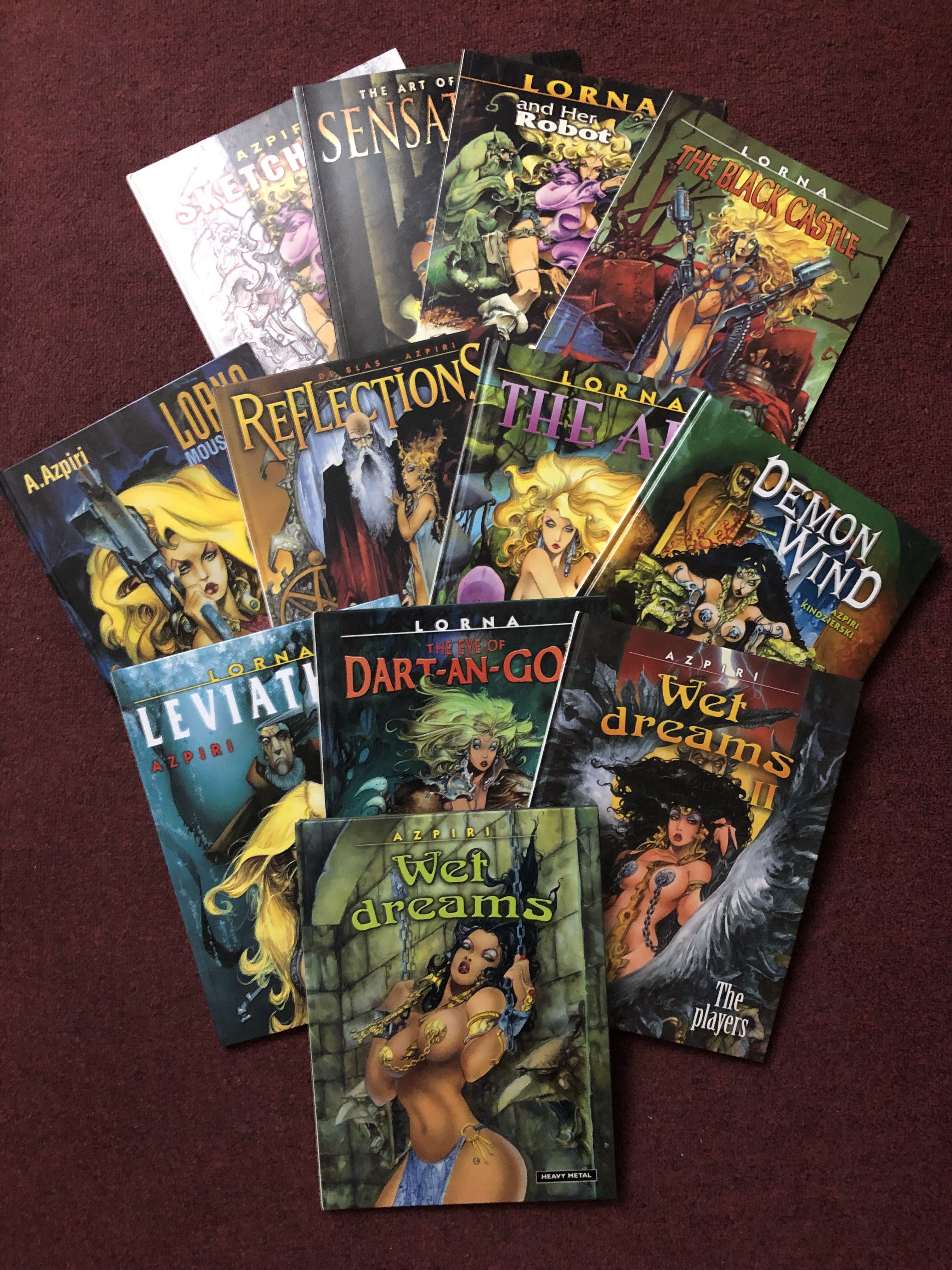
At times you crave something wild, something guttural, primal, unbalanced and unapologetic. Something with a bit more crunch and art that doesn't remind you of Nickelodeon.
Then this arrives...
Real quick: HYPERBOREA -- Nice books! Well laid out with cream, non-glossy, very readable pages. I also ordered a copy of Against The Dark Master, not because I was ever into Rolemaster, but Darkmaster looks awesome too.
But more on those games another time (especially HYPERBOREA), as my mind drifted into this dark realm...
Deathstalkers II: The Fantasy Horror Role-Playing Game, by Mike Whitehead and Joe Meyers, (C) 1999-2005.
I've owned this book for perhaps, 10 years? I saw it at the game store several times before finally pulling the trigger. It was a massive, almost 700 page tome that seemed ridiculous, but I had to buy it, if only for its sheer size and NERVE. It has since sat idle in my collection.
Now, Deathstalkers II, is an interesting game. I would describe it as Palladium Fantasy meets D&D 3.0, with a touch of Warhammer. Seriously, imagine if Palladium never happened until Kevin Siembieda played D&D 3.0 and house-ruled the hell out of it. That is exactly, Deathstalkers II.
Like Palladium, there are many races to choose from, and many of these races have sub-races, so lots of choices. There are plenty of Half-Somethings, but no Half-lings...
Races are where you get your hit points and stat generation, in fact, race is legitimately, half your character. And like Palladium, you roll a different number of dice for different stats depending on your race, for example, minotaurs roll 7d6 for strength, 2d6 for intelligence, faeries only roll 1d4 for strength and constitution, etc. You won't see any 18 strength gnomes in this game! Stats use the 3rd Edition bonus progression, and if it wasn't clear already, 3rd Edition is the backbone of this game, e.g., saving throws are: Fort, Reflex, and Will.
NOTE: This is not WoTC/Disney. If you're looking for balance and harmony among your fantasy races, you won't find it here. Perhaps explore the radiant citadel.
Races have some class restrictions, suggested alignments, and just like Palladium, a listed chance for cannibalism, which is just a descriptive stat that implies a gritty game. Most races have 0% chance of cannibalism while orcs and bestial-minotaurs (there are three types of minotaurs) take the crown at 100%, with goblyns and half-demons coming in at 75% and 70% respectively.
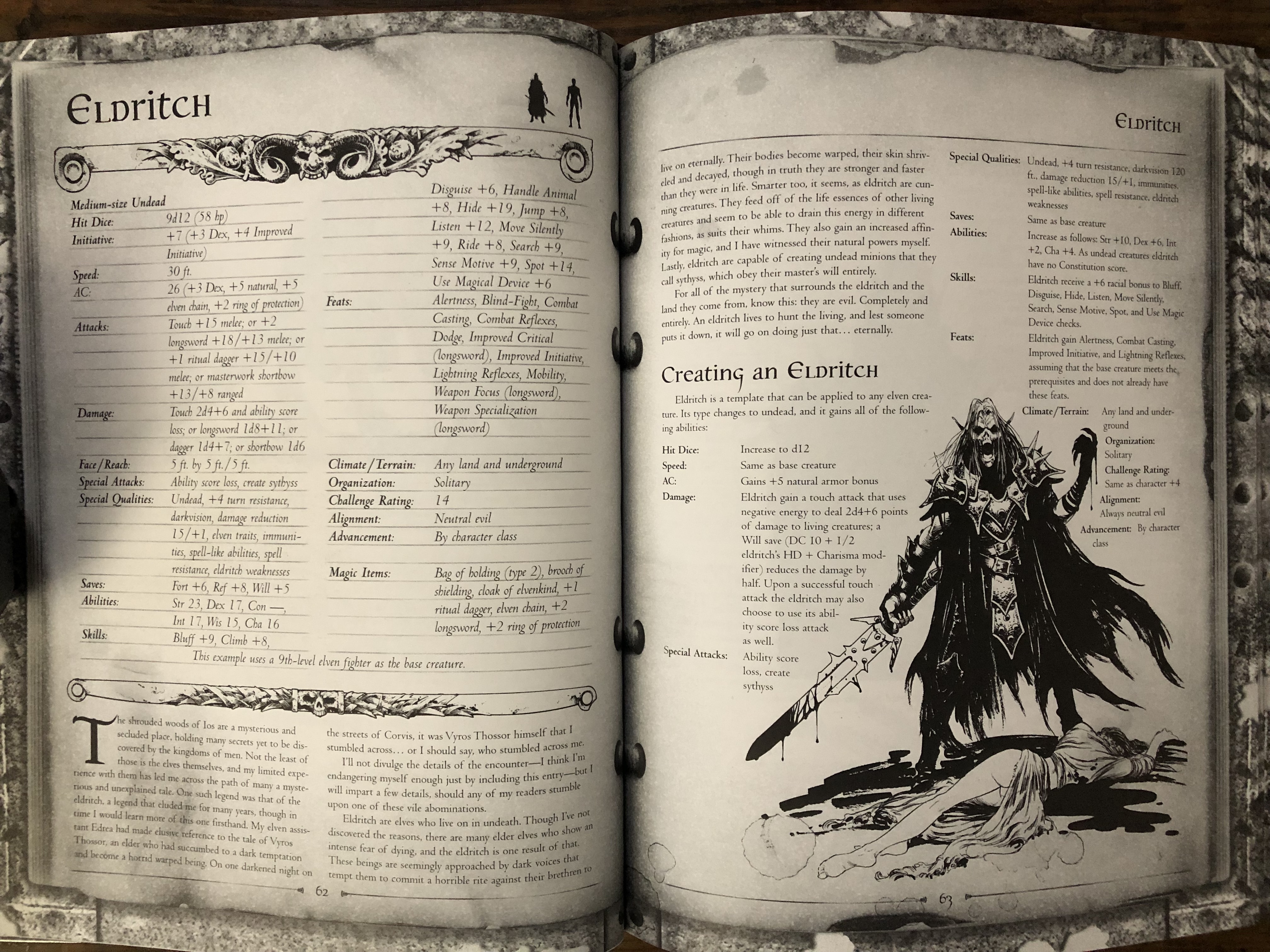
Speaking of those half-demons, they are called the Antithrax. There's only one way an Antithrax comes into existence, and it's not implied like the half-orcs of old. This soulless race lives very bleak lives. The sample Antithrax picture below has hooves and a sword for an arm, but surprisingly, with all of the options in this book, there are no random tables here for rolling up your own unique demonic mutations...
Each race gets something called a Rage-Attack (which is optional) that they can use at the price of temporarily losing Constitution. It reminds me of a Capcom video game ability. For example, the Antithrax can open up a demon-pit of scorching flames around a nearby target doing 4d6 points of damage with no threat of actually igniting the victim. Fueling abilities with your stats, now that's a fascinating concept.
Below: A picture of a West-Lander Gnome. Poor little faerie. Faerie numbers are dwindling in this game world which might have something to do with the fact that eating faerie wings grants nice in-game benefits like granting extra spell castings, gaining 1d10 permanent new hit points, curing diseases, increasing ability scores, etc. You would never see something like this in a mainstream game.
Then we have the classes...
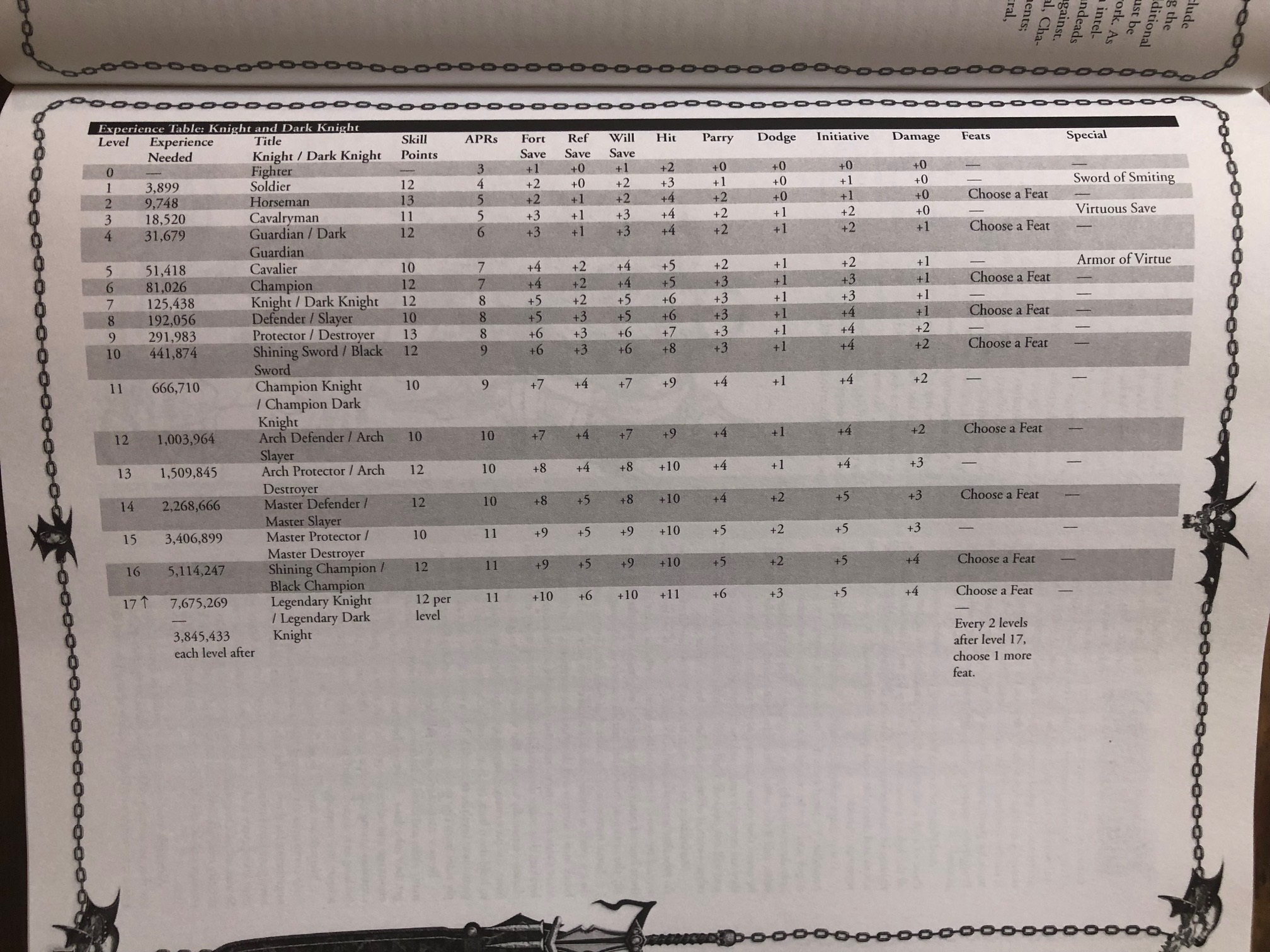
Here is a sample class chart...
And some class art. The art in this book is a cool mixture of pencils and ink. Occasionally, there's a bad piece, but overall, it's pretty damn good.
Characters all start at level 0 and each class gets a certain amount of skill points and a list of preferred skills. They all start with 3 APRs (actions per round.) You get Hit, Parry, Dodge, Initiative, and Damage modifiers, and eventually Feats and Special Abilities. If you want to improve skills or feats before you level-up, you can spend XP to do so -- another interesting concept. Also, non spell-casters can spend XP to gain particular spells. This XP will be spent in the thousands, and, for Legendary Spells, millions!
Multiclassing exists as it does in 3rd Edition D&D, but with limits. Every class has a list of Class Exits, very much like in Warhammer.
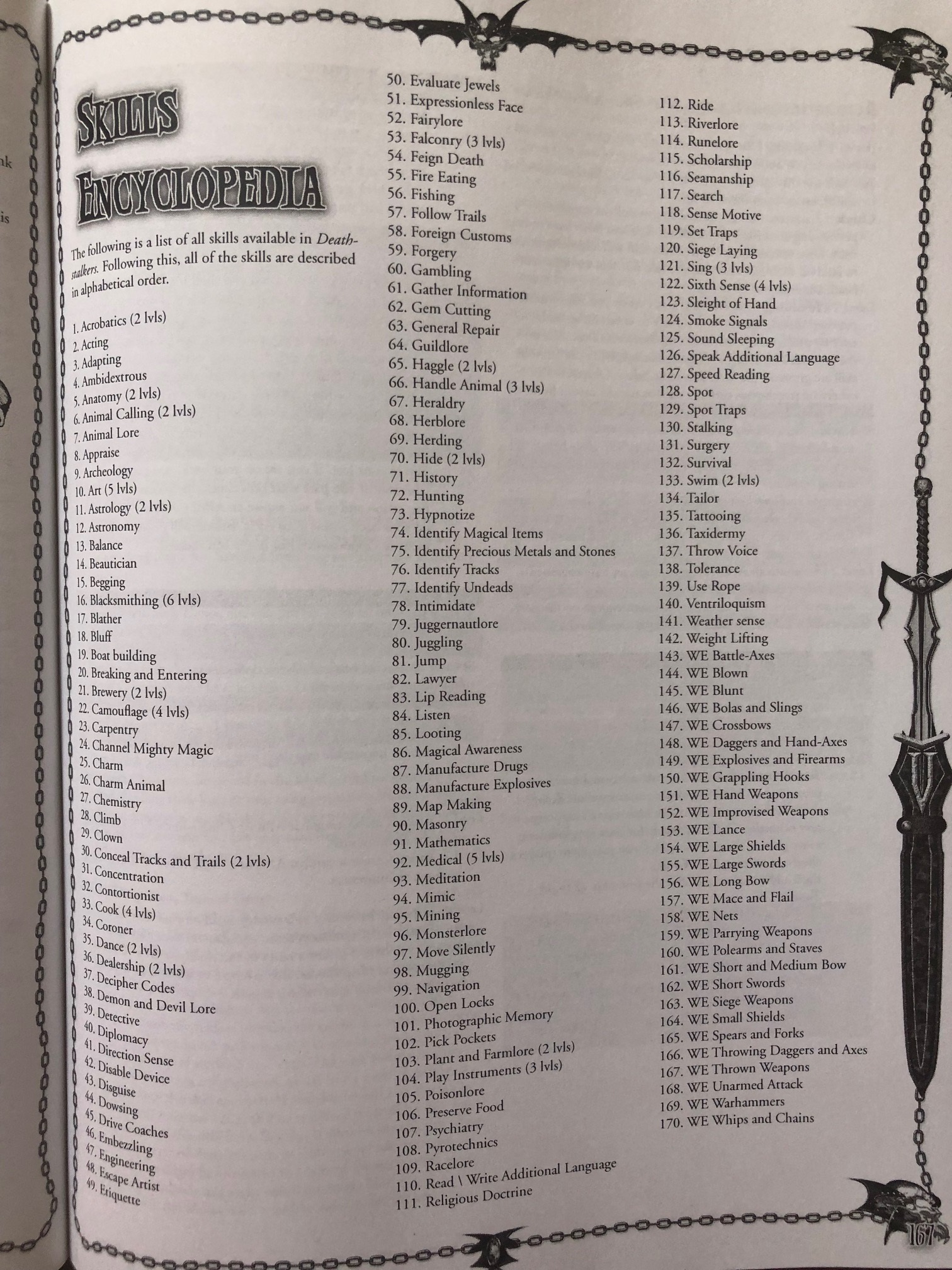
There are a shit-ton of skills and feats, some of which are wild, giving you crazy combat benefits, but with a finite number of uses before you have to repurchase the feat, another cool concept. Some stand-out Feats...
- Aggressive Assault (I-X): One use per round, roll your Aggressive Assault damage die (begins at 1d4) and multiply the result by your level, add this number to your normal damage roll. Aggressive Assault X (character levels 16+) has a damage die of 1d100! Limited number of uses before you must reacquire the feat.
- Fate (I-VIII): Allows re-rolls of attacks, saves, skills, etc. Fate VIII (character levels 3+) revives you from death back to perfect health -- one use only. One of the Half-Cat races begins with this feat. ("Do you want to live forever?")
- Mystic Assault (I-X): Similar to Aggressive Assault, but affects spell damage, range, and other properties.
There are interesting languages, a list of multiple offensive
slang names for each race (such as
Pech for dwarves,
Stain for demons,
Bull and
Cow for minotaurs,
Fleshy for humans,
Halfbreed for a host of others, etc.) Birth Signs give your character a slight bonus. There are rules for insanity and rules for fame -- the grander your achievements, the higher the price on your head!
Combat is similar to Palladium's system, where-in you have a number of actions per round, spent, depending on what you want to do and what abilities/feats you might want to use. Melee attacks are parried and missile attacks are dodged. When you're out of actions, you can go into submissive defense mode where you can still parry (with limited effectiveness) but lose those actions on your next round, or you can take a mauling and hope your armor protects you, which... it won't. Armor is damage reduction, but not nearly enough. Shields add to your Parry score. There are many combat options if you want to use them.
There are over 500 spells in this book. Some new, some old with a different take. Magic-use is a spell-point system. You have X number of castings per day equal to half your Constitution score (keeping fractions) at 1st level and every level there-after. Some spell effects require spending multiple castings. Power Words & Ingredients reduce this cost -- pretty cool.

There are 5 dense pages of herbs and poisons, equipment lists are equally dense. Speaking of, if you want to be proficient in armor, you need to take the armor proficiency feat, regardless of your class, so you won't be wearing plate-mail for a while. Everyone starts out with fairly basic weapons and equipment and a handful of gold. Weapons are priced in the hundreds of gold pieces, e.g. a longsword is 565 GPs (Gpcs as listed in this game.) and damage is higher than you're used to, 2d6, 3d8, 3d10, 4d10, etc. Armor is priced in the high hundreds and well into the thousands. Everything has an availability score. It's a shame that D&D never used availability scores, there should be no guarantee of finding what you want in any particular town, which might give you reason to travel to the next one.

The game world is called, Arkastapha. The premise is one of lost beauty and a land ravaged by thousands of years of wars with Juggernauts -- ironclad golem-knights brought to life by dark Gods using the souls of the damned in the fires of the Dark Forge, and Demons (called Thraxians, once led by the Deathstalkers -- kind of like arch-demons, now in hibernation.) The usual monsters also exist, some with a new twist, and there are a fair number of them. Basically, think bleakness, scattered kingdoms. Points of light in a broken land. The mythology of it all is covered.
The character sheet. Standard, basic stuff. Functional. Could not find a downloadable version online. You know I'll make my own. It will require Pathfinder level complexity as bonuses come from all different directions...
There's an edge to this game that I find refreshing and mechanics that are innovative.
Deathstalkers II: 700 pages of pure F*****G METAL!



.jpg)




.jpg)


.jpg)
.jpg)
.jpg)

.jpg)


.jpg)