Showing posts with label FASERIP. Show all posts

Tuesday, April 2, 2024

Marvel Multiverse Role-Playing Game... What Have We Here?

Strange how things happen...

A couple of weeks ago I dreamed of a comic shop. This one was tucked away, hidden like an adult video store, in the back of a gas station, doorway complete with hanging beads, located in a more run down, but not necessarily seedy part of town. I don't often dream of comic shops, haven't in years, but when I do, they are always somewhat hidden. Two days later, another comic shop dream, another vaguely odd place, though I don't recall exactly where...

Why am I dreaming of comics?

These are hidden treasure dreams. Occasionally, in my youth, I would dream of amazing toy stores -- toy stores you could only dream about. Stores that had everything and then some -- awesome toys that didn't exist.

Then I stumbled across the Marvel Multiverse Role-Playing Game, written by Matt Forbeck, published by Marvel. I had actually heard about it some time ago (months, a year?) and scanned a preview of how it works then promptly dismissed it. Marvel is long overdue for a good role-playing system, because over the years there have been nothing but duds. 

I can't remember what recently brought this game back to my attention (dreams aside) but I bought it on Amazon for about $30, which is approximately 45% off. So why not? Because, apparently, super-heroes are on my brain.

I've eternally searched for the perfect super-hero system. My two favorites, and I've stated this plenty of times, are the Marvel Super Heroes game (FASERIP system) from the 80's and Palladium's Heroes Unlimited, two utterly and completely different games.

Anyhow...

Marvel Multiverse Role-Playing Game is 320 pages, has a high quality binding, and is jammed full of quality, Marvel Comics art (of course I would've preferred art from the 70s, 80s, and 90s, but, that ain't gonna happen.) The layout is good, but the pages have this subtle background hex-mesh (kind of like the stuff hero uniforms are made of in the movies) that threatens to annoy your eyes. A plain white background would've been better, then again, this might not bother younger eyes. Overall, it's a very nice book.

There is branding all over this thing. You have six abilities that spell MARVEL...

  • Melee -- hand-to-hand combat, including throwing
  • Agility -- acrobatics and most ranged attacks
  • Resilience -- your health
  • Vigilance -- your focus and initiative
  • Ego -- magic, leadership, psychic powers
  • Logic -- reasoning and telepathic powers

Notice that there is some blurring between melee and agility, and between ego and logic. Are telepathic powers not psychic powers? This will certainly lead to arguments. Each power states what ability to use and some powers don't require a roll.

Also notice, there is no strength stat. In this game strength is a super power, or rather, a set of super powers (they could have added strength at the bottom and had the stats spell MARVELS.) Stats are ranked from -3 to 9. Average citizens have all 0s. Nowhere is this book are there metrics given for how much your character can lift in actual lbs./tons. I've never seen this before in a super-hero game. Super strength here is kept vague. 

Characters are ranked in power level from 1-6; average citizens, Hand Ninjas*, and Hydra Agents* are rank 1, Hela and Magneto are rank 6. Spiderman(Peter Parker) and Captain America are both rank 4. If you're a fan, Miles Morales is rank 3. Daredevil and Elektra are both rank 2. 

*Hydra Agents are actually tougher (more health) than Hand Ninjas (same health as Aunt May!) -- something I find unbelievably bizarre. I'm sure the author is trying to set up scenes of Daredevil or Wolverine plowing through ninja-hordes, but in my mind, one Hand Ninja would slaughter several Hydra Agents... easily. Debates on the accuracy of character stats can be found on various forums -- this is inevitable for such a game. (Since when does Sam Wilson have super-strength?)

You have two hit point scores, Health and Focus, obviously physical and mental, which equal 30 times your Resilience and Vigilance, respectively (though Focus functions as a combo of physical and mental endurance.) A Resilience of 3 gives you 90 Health and a Vigilance of 5 gives you 150 Focus. Using some powers requires you to spend Focus. 0 Health equals unconscious while negative Health equals dead (thankfully they didn't shy away from death in this game, but then again, comic book death...) 0 Focus equals demoralized which means you can't use certain powers and you have the equivalent of disadvantage (here it is called trouble) on all rolls. Negative Focus equals shattered, meaning your will is completely broken, so not dead, but definitely taking a hiatus (perhaps your title got cancelled...)

Characters are built with a sort-of point buy system (yuck). Decide what rank your game will be and build heroes accordingly. Rank mainly decides how many powers/traits/ability-points you have and how much damage you do. Gaining ranks is handled vaguely, basically you rank-up whenever the Narrator (FASERIP's Judge was a better GM title, Narrator sends the wrong message to my ears) feels is reasonable, perhaps every 4-6 sessions (a graphic novel) but this would be far too fast. How do you explain a rank 1 rookie becoming a cosmic power in a matter of months? This isn't D&D. To the game's credit, it states that the official Marvel characters can't go any higher than they are and does sort-of warn against advancing your own too quickly. I would probably come up with some sort of system reminiscent of FASERIPs karma advancement. It would be very slow with plenty of limitations. Comic characters take years to change just a little bit. It is a curious genre that way. Almost all others RPG genres expect a fairly regular pace of improvement. Fighting crime is truly for the love of the game.

Your hero will be made up of the above mentioned stats plus an origin, occupation, tags, traits, and a multitude of powers. And by multitude, I mean multitude. Powers are built like feat trees, meaning certain powers have prerequisites, and those prerequisites have prerequisites. For example, in the super-speed category of powers, you can't take catch bullets until you take speed run 2 and your hero must be at least rank 3. Captain America's ability to punch someone with his shield is a power called shield-bash, so if you want to build a shield-bearer (this is a power set) you might want to start with shield-bash!

Power trees.

(Of note: Specific powers like penance stare exist in the game, but Daredevil's radar sense does not. Instead, his powers are summed up under the moniker of heightened senses. Nowhere on Daredevil's character sheet is radar sense even mentioned. Likewise, Psylocke's famous psi-blade is not mentioned either (not even in parenthesis.) This power uses the generic term of mental punch, a melee attack that damages Focus instead of Health and stuns on a fantastic success. I've never seen her psi-blade not stun someone, of course, I only recall ever seeing her stab targets through their skull, perhaps a psi-blade to the arm merely hurts.)

Origins nicely cover the usual tropes: Various Aliens, High Techs, Mutants, Monsters, etc. These give you certain tags, traits, and even powers (with some limitations) these are powers you must take before choosing any others, and sometimes, as with vampires and werewolves, these are the only powers you get.

Occupations offer more tags and traits, e.g., lawyer, entertainer, journalist, outsider, spy.

Tags are mere fluff descriptors like: mysterious, streetwise, rich, secret I.D., young, etc. These offer no mechanical benefits. 

  • But, they could... What if the hounded, hunted, and enemy tags meant that if you roll a fantastic failure (see below) or a new dice combo like triple 1s (1M1) members of an enemy organization or an arch-nemesis shows up to complicate your current situation? Or if you had the dependent tag, in the middle of the fight you find out a loved one is in danger somewhere else? Tags could have positive effects too if you roll a 6M6, such as allies arriving to help turn the tide (there is a backup tag.) This is what I would absolutely do.

Traits are like the old FASERIP talents which offer a slight edge to this or that roll. They sound just like tags though: iron will, loner, pundit, small, sneaky, etc.

Sample characters and sheets...


This is what Spiderman would look like if you created him yourself (on the right.) There would be a back page with the rest of his powers listed. See what I mean by a multitude of powers? BTW, there is a power-group of spider powers for people who love the spider-verse and wish to create their own spiderman (spider-verse book due out around the end of the year.)

Also, I would add an Action section to this character sheet. Everyone gets 1 standard action, 1 movement action, and 1 reaction. The trait combat reflexes gives you 1 additional reaction. It would be nice to see this at a glance. All powers fit into one of these action categories.

Most likely I'll be designing my own sheet.

Game Mechanics... Make or brake time. The stat block below is really the core of your character:

Of your 6 standard abilities, you can attack and do damage with 4 of them --melee, agility, ego, and logic. As already stated, resilience and vigilance set your health and focus. All 6 are important. All 6 also have a defense score, an armor class if you will, your score +10 + power bonuses. In melee combat, you roll against your targets melee defense. When shooting, you roll vs. their agility. Now, I love opposed rolls, but this is certainly the next best thing. For non combat rolls, you simply add your score (which may have a power bonus) to the 3D6 roll. And there in lies the mechanic... 3D6.

3D6

One die needs to be a different color from the other two. This die is called the MARVEL die. Official dice are sold in packs of 12, so 4 sets, for $16 -- not bad. The MARVEL die reads MARVEL in place of the 1.

The basic mechanic is: Roll 3D6 (referred to as D616, more branding, the Marvel earth is earth 616.) Anyway, if you're trying to punch someone, roll 3D6 + your melee score and meet or beat your target's melee defense. That's it, those are the basics. The same applies to agility, ego, and logic.

If you hit, the MARVEL die represents damage. Take that number and multiply it by your damage multiplier (limited by your Rank, e.g., rank 4 = x4 damage multiplier, some powers expand this) then add your melee score on top of that. 

If the MARVEL die comes up, MARVEL, it's called a fantastic success and you do double damage. 6MARVEL6 (6M6) is an ultimate fantastic success for triple damage. Powers and weapons will trigger other effects too, like stunning and knockback.

You can have a fantastic failure as well -- you fail but something strange happens that benefits you, sort of like failing forward. That's OK, but a missed opportunity for classic tropes like spiderman running out of web-fluid (if using a web power.) 

Some powers, traits, situations, give you edge or trouble, meaning you reroll the best or worst die. You can have double edge and double trouble too.

There is also Karma (a nice throwback to FASERIP.) You get a number of karma equal to your rank and can spend it to give yourself an edge or an opponent trouble, and to recover some health. BTW, edge and trouble are mentioned throughout the book without being in italics or bold print, I find this odd as they are terms that should always stand out.

The mechanics are simple and elegant. I actually like them. Lucky rolls can quickly knock people out of combat and also allow you to survive against powerful foes. There is however, one philosophical flaw in this game: Setting target numbers for non-combat challenges...


Target numbers are set based on your hero's rank. So, jumping from one roof-top to another (if set at challenging) will be TN:12 if you're rank 2, but for a rank 4 hero it's TN:14. What if they were jumping at the same time? Shouldn't it be easier for the rank 4 hero? This is an all-things-equal storytelling mechanic... not a fan. I think this assumes all heroes playing are the same rank, something else I'm not a fan of. I would set one TN regardless of who's attempting the feat. Easy fix, not a game-breaker.

Another thing, your damage multiplier is based on your rank. So rank 1 has a x1 multiplier and rank 6 has a x6 multiplier (remember this multiplier is applied to the results of the MARVEL die.) This applies to all 4 attack types, melee, agility, ego, and logic. Jean Grey is rank 6 so her melee damage multiplier is x6. Her melee score is 1, so not a great fighter, but if she did hit you she would do more damage than Daredevil and maybe even Captain America or Wolverine! Her mental powers do more damage than her fists, so she shouldn't bother trying to punch you, but if she did... This is a weird byproduct of this system. Obviously you could just say there was a little telekinesis in that punch (even though she has a separate telekinetic punch power, which is a logic vs. melee roll, just so you know.)

All in all, as it stands right now, I call this is a good game. So I'll say: Well done MARVEL (not a company I've praised in a long time -- the movies are terrible and it looks like they'll continue to be.) Time will tell though, as this RPG is still very new. The more people that play it, the more optimum power-builds will be revealed and then every created hero will look the same. Every one is going to take the equivalent of "super-strength" in their preferred damage mode and they will also take damage reduction in both Health and Focus -- you'd be dumb not to. And you'll have one attack that targets Health and one that targets Focus enabling you to zero in on a foe's weak spot. Also, EVERYONE will take the trait combat reflexes. Everyone will have flight. And these will only be half of your powers. This is why random character creation will always be superior to builds

Two books are out, the core rules and the Cataclysm of Kang Adventure which stats out a bunch more heroes/villains (the adventure part, I could care less about -- published super-hero adventures are always rail-roads of the highest degree.) An X-Men book is due out in August and a Spider-Verse book after that. These books are slated to have tons of hero stats and new powers and new rules. Eventually, I imagine, there will and should be, a Powers book. They should call it Ultimate Power (FASERIP had the Ultimate Powers Book.)


What I would love to see, and will most likely end up doing myself, is a random character generation system, not concerned with or limited by balance and rank. The actual X-Men aren't balanced nor are the Avengers and nor should your game be, well, my game anyway.

Now go clobber something!


Wednesday, December 29, 2021

Marvel FASERIP And Random Character Generation


Nothing beats RANDOM character generation.

Marvel Super Heroes (FASERIP) is the all time king of random character generation (Traveller is up there, and Heroes Unlimited too.) Often in Marvel, you have to make sense of truly odd power combinations, and many times back yonder, we would just reroll. Screw that. Random generation allows you to create characters that you would never otherwise think of. 

It is the path to true originality.

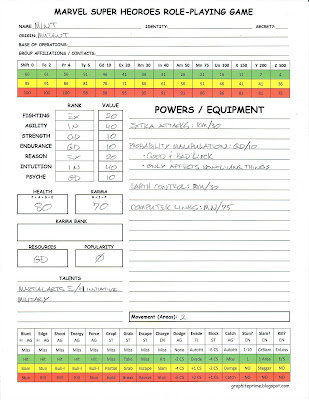
I rolled up this character in all of 10 minutes, 100% random, no fudging, no rerolls.

A Mutant...

Improve their Endurance by 1 rank (nice, since I only rolled Typical(6)), one extra power, and zero popularity.

Stats are decent, Health is on par with a lot of street level heroes. 

Talents are Military (plenty of sub-plots here, experimented on? Spy?) and Martial Arts E (+1 to initiative, actually makes sense as her two highest stats are Agility and Intuition at Incredible(40) each.)

Powers:

  • Extra Attacks
  • Probability Manipulation* -- counts as two powers (I rolled 4, +1 for being a Mutant)
  • Earth Control
  • Computer Links

What a group!

Looking for patterns...

She can change outcomes, Probability Manipulation (reverses % die rolls), for better and for worse, but only for non-living things -- like making a gun jam. She can manipulate the earth itself, Earth Control (that's earth in an elemental way, as in... dirt) and she has an immensely powerful (Monstrous (75)) connection with computers. Almost sounds like she's from a simulation, a virtual reality, or that's the way she sees reality. She's an architect, a creator, a shaper of the world.

I named her Mint (thought of Warp, Architect, Shaper, etc.)

Extra Attacks, according to the rules, simply gives her a better shot at rolling to see if she can make an extra attack. I prefer to see this power as a minor form of Super Speed, or Super Multi-Tasking. I would allow her to use two powers in one round (makes sense too with her Agility/Intuition.) Perhaps she appears somewhat pixelated when she moves or her Earth Control manifests in a pixilated way like in Minecraft (which I've never played.) Could have called her Pixi...  

Earth Control, at the beginning stage only allows you to use clumps of earth to bash and block. There are several other useful things you can develop as power stunts, tunneling, traveling on waves of earth, grappling, earthquakes, sculpting golems, etc.

She can block and bash, bash twice, bash two separate foes, manipulate and bash, manipulate twice, block block, etc.

Combat with this character would never be dull.

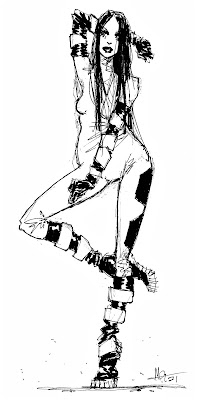
Perhaps she looks like this...


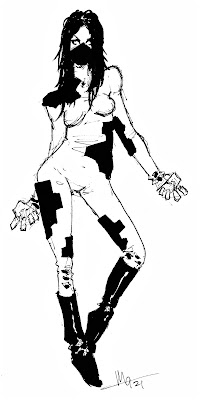
Or this...

FASERIP -- Best Super-Hero system ever!

It's not even close.


Sunday, March 7, 2021

Marvel (FASERIP) Praise + Revised Character Sheets

Opal. See stats below.

So there I was, experimenting with different ways to draw dungeons, when out of the blue, Marvel popped into my head, and stayed there (such is my brain.) I should redesign the character sheet, I thought...again. Make it more user friendly. Put the charts (Universal Table) directly onto the sheet. People don't really like charts any more. They can be very useful, but the Holy Grail of game design -- well, charts don't seem to belong.

But Marvel Super Heroes (FASERIP) is the greatest super-hero role-playing game ever made. Even though I played it to death, haven't touched it in years, having moved on to Heroes Unlimited or some variation there-of, including whole systems invented by yours truly (should post them here one day.) I now feel that no game captured comics like Marvel did.

Next thing you know, it's 3 A.M. and my sheet's been redesigned, with variations over the next couple of days. I guess the dungeons will have to wait a minute.

Marvel Super Heroes is such a solid game, they could republish it today with minimal tweaks. Our young minds didn't appreciate the finer details enough. We never used the defensive maneuvers (how cool is block? -- granted I would use it more proactively than rules-as-written) and we weren't all that creative with our powers -- some of which need to be fleshed out a bit more and given more practical use examples. 

Another thing Marvel could've done better is character creation. As it stands, it's completely random -- which is a good thing, I love making sense of random rolls, but, there should be more archetypes available. Something like this:

01-20  Altered Human
            01-50   Experiment
                                01-60  Super-Soldier (usually no powers, but very good stats + weapons)
                                61-80  Altered Form (animal, plant, mineral, etc.)
                                81-00  Random Powers
            51-00   Accident
                                01-50  Altered Form (animal, plant, mineral, etc.)
                                51-00  Random Powers
21-40  Mystic   
            01-40   Martial Artist (plenty of fighting talents, limited selection of mystic abilities)
            41-70   Sorcerer (quite a few lower powered powers "spells")  
            71-00   Mystically Bestowed
                                01-30  Random Powers
                                31-80  Magic Weapon/Item
                                81-00  Altered Form (animal, plant, mineral, etc.)
41-60  Mutant
            01-30   Altered Form (animal, plant, mineral, etc.)
            31-50   Experiment (Random Power + a cybernetic or two.)
            51-00   Random Powers 

61-80  Hi-Tech
            01-40   Power Suit (roll on list of powers commonly found in battle armor)
            41-70   Gadgeteer (each power is a separate gadget)
            71-00   Cybernetics (roll on list of enhancements)

81-90  Robot
            01-20   Swarm
            21-60   Android -Human Form (random powers)
            61-80   Non-Human Form
            81-00   Transforming

91-00  Alien
            01-20   Altered Form (animal, plant, mineral, etc.)
            21-80   Alien race (list of strange beings, multiple eyes, arms, etc.)
            81-00   Myth or Legend

There's tons of fan stuff for FASERIP out there. Many have expanded the universal table to include new in-between ranks such as: Awesome, Fantastic, Sensational, etc. I've looked into this before, but now I feel that it isn't necessary. I always felt Monstrous as a descriptor didn't quite fit. If I had to replace it from the list below, I'd probably choose Sensational.  Anyhow, here's a list of words you could use if you're looking to expand:

  • Awesome
  • Marvelous
  • Outstanding
  • Uncanny
  • Magnificent
  • Sensational
  • Spectacular
  • Astonishing
  • Fantastic
  • Impressive
  • Astounding
  • Exceptional
  • Stunning

And if you wanted to play a horror themed Marvel game you could rename the ranks from the following list:
  • Dreadful
  • Horrendous
  • Terrible
  • Ghastly
  • Unspeakable
  • Atrocious
  • Shocking
  • Pathetic
  • Nightmarish
  • Awful
  • Eerie
  • Abominable
  • Lousy
  • Alarming
  • Daunting
  • Formidable
  • Harrowing
  • Distressing
  • Terrifying
  • Ungodly
  • Mundane
  • Maniacal
  • Demented
  • Beyond
  • Unreal
  • Ridiculous

Let's give it a whirl:
  • Feeble -- Pathetic (2)
  • Poor -- Lousy (4)
  • Typical -- Mundane (6)
  • Good -- Formidable (10)
  • Excellent -- Daunting (20)
  • Remarkable -- Alarming (30)
  • Incredible -- Shocking (40)
  • Amazing --  Ghastly (50)
  • Monstrous -- Maniacal (75)
  • Unearthly -- Horrific (100)
  • Shift X -- Abominable (150)
  • Shift Y -- Unspeakable (200)
  • Shift Z -- Beyond (500)

An oddity with the Universal Table: Shift X and Shift Y are almost identical. First of all, in my humble opinion, Shift Y should be 250, not 200. A yellow success should be 36, not 41, and Shift Z's yellow should be 31, not 36. Ignore what this does to the Class 1000 side of things -- those ranks are pointless to regular super-hero game-play.


No creation charts allowed you to roll up really powerful characters -- Unearthly and up (not even the Ultimate Powers Book.) But you could use a chart like this:

01-10  Good (10)
11-20  Excellent (20)
21-35  Remarkable (30)
36-55  Incredible (40)
56-70  Amazing (50)
71-80  Monstrous (75)
81-90  Unearthly (100)
91-94  Shift X (150)
95-99  Shift Y (200) or (250)
   00    Shift Z (500)

Or if you want to limit things to Shift X...

01-05  Typical (6)
06-15  Good (10)
16-25  Excellent (20)
26-45  Remarkable (30)
46-65  Incredible (40)
66-80  Amazing (50)
81-90  Monstrous (75)
91-98  Unearthly (100)
99-00  Shift X (150)


The Character Sheets!

In order to make the result table fit, I combined the Blunt & Edge, Fighting & Agility results columns into one. This means you can now Slam with a throwing blunt attack. Which actually fits -- how many times have you seen Cap's thrown Shield or Thor's flying Hammer slam an opponent into the next area? How about a certain cinematic manhole cover? -- "Superman...!"

This was the first revision. The idea was to record the numbers you need to roll for each color feat, per ability...

Marvel FASERIP Revised A


Then I decided to simply include a condensed version of the whole Universal Table showing the rolls needed for every rank...


And then I added lines...


And here's a sample character named Opal, an entity from the Darkforce Dimension -- that's all we know, that's all we'll ever know, because mysterious is better, every time. For a randomly rolled character, she makes a lot of sense. She can't control the Darkforce like Cloak, but she can generate it, and that stunning option is enormously powerful -- stun your opponent for 1d10 rounds if they fail their endurance roll. Yikes! I would allow and endurance roll every round to snap out of it. Maybe I would change it to touch only (she reaches an ethereal Darkforce hand inside you and grasps your heart...!) She makes a good villain, dangerous, and if she starts to lose, Bamph! -- she's gone to the Darkforce Dimension --she has to roll for that, of course.

And Martial Arts D allows her to slam and stun opponents with body armor who take no actual damage from the attack (I would ignore the fact that you're supposed to study your target for 2 rounds first, hate that kind of crap.) Very useful considering she only has typical strength, i.e., if she ever finds herself unable to generate Darkforce blasts. This Talent is an example of something we almost certainly overlooked or forgot while playing.


So play some Marvel, have a blast! And remember, when villains win, they usually leave the hero lying battered and unconscious in a dark alley or they capture them and leave them unattended in some sort of death trap. Playing one-on-one? -- introduce a new hero who has to rescue the first one (guest starring, the Marvelous _________!)

And keep track of the villains that you've captured, who are now locked up in a super-max facility. When in need of a random encounter, create a random breakout table. No need to explain how...

Could look something like this:

  1  Doctor Octopus  
  2  Vulture
  3  Scorpion
  4  Electro
  5  Sandman
  6  Hobgoblin
  7  Speed Demon
  8  Hydro-Man
  9  Roll Twice
10  Everyone on this list!

And what are they doing...?

  1  Robbing a bank  
  2  Hunting Spider-Man
  3  Hunting __________
  4  Building a new Secret Base
  5  Recruiting henchmen
  6  Raiding a scientific laboratory
  7  Planting a bomb
  8  Holding a hostage
  9  Marauding maniacally
10  Whereabouts unknown...

Their Secret Base is...

  1  In the sewers  
  2  The top floor of a sky-scraper
  3  An abandoned warehouse
  4  Underwater
  5  Basement of an old house
  6  A penthouse apartment
  7  A mobile truck or van
  8  A junkyard
  9  An old factory
10  Hidden in an iconic landmark

It's Clobberin' Time!


Sunday, May 10, 2020

Combat Mechanics


The years I spent searching for the perfect system that doesn't exist.  And by system, I generally mean, combat system.

Only to discover the OSR and the notion that the older systems are all you really need, i.e, tweaked of course, but a solid foundation.  There's lots of cool little ideas and dice tricks in the OSR universe to spice up your games.  If you care about mechanics.  And I do.

D&D combat is illogical.  That's not exactly news.  It's always been an abstraction, one originally designed to simulate armies against armies, not necessarily man against man.

Two 1st level fighters should fight to a stand still.  Yes, maybe one's a little stronger or one's a little quicker, but they're basically evenly matched.  Their level is their fighting skill.  Two 5th level fighters should also fight to a stand still as should two 10th level fighters, and so on.  A 5th level fighter should whoop a 1st level fighter -- here the rules accurately account, if only because of hit points.

The main difference in these duels is that the 1st level fighters, though evenly matched, will see one of the fighters fall quickly do to a lack of hit points, were as the 5th & 10th level fighters toil on and on.  Two evenly matched fighters of any level should toil on and on.  So logically, should hit points change depending on your opponent?  That's not gonna happen.  If anything damage should change, which does happen somewhat.

My chances of defeating my opponent rest mainly on how good my fighting skills are compared to his.  Yes armor plays a roll, but it only delays my pummeling of a lesser opponent.  This dovetails directly into the notion of armor as damage reduction.

Armor Class.  It makes perfect sense for ranged combat.  Most people can't dodge arrows even if they know they're coming, so basically, distance and what armor your target wears are your primary obstacles to a successful hit.  Shields should factor more.  In fact, shields in general are way undervalued.  If entering combat and I had to choose sword or shield, I would strongly consider choosing shield.

One of my favorite representation of man to man combat was in the DC Heroes RPG by Mayfair Games.  A system referred to by some as, MEGS.  The system is 2d10.  On the Action table, cross reference your score vs. your opponent's score (usually Dex vs. Dex) to find the number you need to meet or beat.  If you roll doubles you get to roll another 2d10 (I would consider changing this to simply rolling another 1d10 to avoid ridiculous, if not rare, outcomes.)  Notice on the Action table that evenly matched foes of any power level have to roll an 11 to hit.


Then you cross reference your effect value (usually Strength) against your opponent's Body score (modified by armor) on the Result table, including any column shifts from your success to see the damage inflicted.  But once again, a fight between evenly matched "regular folk" won't last long because of low health values.  Still, it's elegant.  Buuutttt...CHARTS.  They slow the game down, or do they really?  We never had problems with charts when we used them. 

Charts were a thing in the 80's.  By the 90's they were pretty much obsolete.  The thing with charts though, is that they can provide fairly logical results for a system.  Marvel's FASERIP system used charts well.  The huge flaw in FASERIP though, is that your foe's fighting skill had no bearing on whether or not you could hit them.  The chart simply existed to determine how well you hit them.  Your average person, with Typical rank Fighting, has a 50% chance of hitting anyone.


Then there's Palladium.  Strike, Parry, Dodge, Roll with Punch....!  A very granular, opposed roll, chart-less system, love it or hate it.  I love it.  Ideal for one man vs. another.  Five on five?... good luck with that.  Palladium Fantasy uses the same system, but this type of combat takes far to long for a dungeon crawl (and ultimately, it's all about accommodating a dungeon crawl!)  This type of system almost requires a comic book (cinematic) style of action narration.

Notice how in comics and movies, when groups fight each other, they focus on one or two characters at a time.  You'll see a series of actions, strikes, and parries before switching to another character.  Often, the results of the first little scene will lead directly to the next, for example, the next two combatants will move into the background of someone else's scene before becoming the focus themselves.  This brings up a whole 'nother aspect -- initiative and turn order.

One of the reasons that D&D combat can be tedious and not dynamic, is that it's essentially a frame by frame narration, going from fastest to slowest.  You go first, swing and miss.  The scene immediately switches to the other side of the room where someone else acts.  Then the focus switches again.  You rarely get to see an immediate rebuttal from your foe.  Not very exciting.

What if, you focused on whoever acted first for a couple of rounds of give and take, and then switched to the next person for a couple of rounds.  Does everyone declare their intentions first and have to stick with them?  Or do you keep it fluid and let people choose their actions depending on the events of those that went before?  It gives everyone a bit of a spotlight for a few moments instead of the regular slow-motion chess game.  Of course it causes problems for spell durations and stun durations and rules-lawyers would absolutely lose their minds!  It would take a strong DM.

Another game system that had wild potential in my book is Iron Kingdoms.  Love its use of derived stats and the 2d6/3d6 resolution mechanic has all kinds of potential for cool little dice tricks.  But it's basically a glorified miniatures game, practically requires them.  I would do away with the FEAT point system entirely.  And magic would need modification as every spell is simply a different version of magic missile.  Man, this game could have been it.....

Where have I gone with this ramble???

Back to mano-a-mano and D&D.  Without rewriting the rules all together, the simplest solution for me has been to add a parry option.  An active parry option, not a +2 or +4 bonus to AC for fighting defensively -- far too passive for my taste.  You don't want to bog the game down with parries, so it's just an option.  If you haven't already acted, you can try to parry an incoming attack.  Meet or beat the attack roll with one of your own.  Perhaps a bonus if using a shield (or advantage.)  Then you can't attack that round.  If you're playing your character realistically, they would always choose to parry if they could (unless you really embrace hit points as endurance and fate, which they kind of are.)  Perhaps Barbarians (berserkers) don't ever get the option.  It slows combat down a bit because there will be successful parries, but that combat is more exciting, a touch more real.

Just some stuff I always think about.

And then there's the quest for the perfect, non-Vancian magic system...


Sunday, February 23, 2020

Super Hero Campaigns: Patrolling The City


 As I've said before, my favorite superhero systems are Marvel FASERIP, DC Heroes (Mayfair Games), and Heroes Unlimited by Palladium Games, however, the following tables are system neutral.

What you will need for this to work are your own, ever-growing, random lists of villains and heroes (separate lists), perhaps columns of 10 each so that you can easily add future columns.  Results should include solo villains and villain groups the likes of:  Hydra, A.I.M., and The Hand, also Aliens and Monsters.  You should have stats for all results ready to go, including stats for thugs, cops, wild animals, etc.  If a villain is rolled who should be in jail, they've obviously escaped.

This is meant to emulate the classic trope of a single hero or super-team patrolling their city on the look-out for crime on any given day or night.  You do not need a city-map, but having one wouldn't hurt.  Every time you roll on these tables equals a comic book Issue (as in a 22 page monthly Issue.)  Every time you roll on these tables something will happen.  Results may need a little tweaking to make sense.  Take notes and switch between heroes and groups every so often to create your own comic book universe!

  • To simulate time passed between Issues, roll 2d6.  The result equals the number of days passed since something happened on patrol (for that Title.)  You may or may not have been patrolling during those days, either way, nothing of note occurred.

Location of Crime, d12
1.  Sewers
2.  Docks (shipping district)
3.  Mall (shopping district)
4.  Skyscraper (downtown)
5.  Warehouse District
6.  Airport
7.  Art District (museums, theaters)
8.  Slums
9.  Uptown (wealthy district)
10. College campus
11. Iconic bridge or Park (zoo, cemetery)
12. Subway system

Type of Crime or Incident, d20

1.  Kidnapping:  You witness this as it happens, someone is grabbed and thrown into a van or flown away (if a flying villain.) 1-2  child, 3-4  man, 5-6  woman.

2.  Assault:  A woman screams and is struggling with an assailant(s).

3.  Drug smuggling:  You witness a major drug transaction, 1d6+2 well-armed gangsters on both sides.

4.  Human trafficking:  2d6+10 people (usually immigrants but can be of any origin, even extra-terrestrial) being loaded onto a truck.

5.  Bank robbery:  The classic crime, you hear the alarms going off.

6.  Sniper:  Usually just a single psycho shooting from above, randomly targeting civilians.  By the time you arrive, you've heard 3d6 shots resulting in 2d6 casualties.

7.  Gang War:  2d6+6 well-armed gangsters on both sides shooting it out, why get invovled?--1d6+2 civilians are in harms way.

8.  Murder:  You heard the scream, but arrive to find the deed done with the perp(s) standing over the body.  Victim was a 1. lover, 2. rival, 3. cop, 4. thug, 5. politician, 6. john doe.

9.  Mugging:  Another classic crime, you hear the screams.

10. Arson/Vandalism:  Something is burning or being destroyed, perps are present.  


11. Hostage situation:  2d6+12 hostages are being kept inside a(n) 1. office (1d6 x 10 floors up), 2. church, 3. store, 4. school, 5. theater, 6. mansion.  They will terminate 1 hostage every hour if demands aren't met.

12. Riot, looting & destruction:  3d6 x 10 protesters/anarchists are venting, innocents are in danger, property is being destroyed.

13. Hero(s) fighting Villain(s):  You stumble across a fight between a fellow hero and a villain, or multiples 1d4 vs. 1d4.  

14. Rampage:  A monster or robot is tearing up the town.

15. Hero fighting Hero:  Fellow heroes are fighting, it's getting serious.  Why are they fighting?:  1.  lovers quarrel,  2. one is is being overly territorial,  3. one is trying to prevent the other from going bad,  4. one is being mind-controlled by a villain,  5. one is a cocky new kid on the block,  6. they are just sparring.  

16. Villain fighting Villain:  Two villains intent on ending each other.  Why are they fighting?:  1.  lovers quarrel,  2. one stole the others loot,  3. one is sick of being bad,  4. one murdered the other's friend,  5. one has a "hit" on the other,  6. they are just sparring.

17. Jail-Break:  5d6 inmates are spilling out onto the streets.  If this is a super-breakout, you're in trouble.

18. Serial-Killer strikes:  You hear screams, someone has found a body.  You need to make a difficult Intuition/Awareness/Perception check (e.g., Red result in Marvel) to catch the trail of the killer, otherwise they got away.  If this is rolled again it's the same killer if they haven't yet been caught.  Victim is: 1. a child,  2. a prostitute,  3. a hero,  4. a villain,  5. a random civilian,  6. an animal.  Victim type will be the same every time until caught.  

19. High speed car chase/shoot-out:  Multiple vehicles, could be gangsters or cops and robbers.

20. Power-outage, (riot plus 2 more rolls):  All hell has broken loose.

Criminal, d12
1.  Single thug
2.  1d4+1 thugs
3.  1d6+2 thugs  
4.  2d6+3 thugs
5.  Super Villain
6.  Super Villains, 2
7.  Super Villains: 1d4+2
8.  Super Hero gone bad (anti-hero)
9.  Super Villain with 1d4+1 thugs
10. Super Villain with 1d6+2 thugs
11. Super Villain with 1d10+3 thugs
12. Terrorists, 2d6+6

Complications, 1 in 6 chance
1.  A friend or dependent is in harms way.
2.  If you are hunted by someone, they show up.
3.  You have the flu and fight with some sort of disadvantage.
4.  A rival hero or arch-nemesis shows up.
5.  Bad weather, torrential rain or blizzard complicates rolls.
6.  Media is present and recording everything.


Wednesday, January 2, 2019

DCC Dice Meets FASERIP


I've said before how the Marvel (FASERIP) RPG was my go to super-hero system for years, so much so that it nearly ruined percentile systems for me -- I probably passed on a lot of good games over the years simply because I was so sick of rolling percentile dice.  These days I don't care so much, whatever works.

The other two super-hero systems that I like are DC Heroes (Mayfair Games) and Heroes Unlimited by Palladium.  Notice a trend?  All three are old-school games.  I would love to encounter a modern super-hero game that I liked, but I haven't (Mutants and Masterminds isn't bad, so I suppose an honorable mention...)  Most modern super-hero games seem to be "story-based"-- not my cup of tea.  Some of the games do look like nice products, so I'll give them credit for that.

The last Marvel game (Marvel Heroic) was terrible, not trying to offend anyone, it just was.  It's flaws?  1.  Being forced to not only play Marvel characters, but, Marvel stories as well.  Stories, I might add, that you've probably already read.  2.  No robust character creation rules, though I think something half-assed was added later.  People ALWAYS want to create there own characters.  The Marvel (or DC) universe should simply be a guideline, a sample setting, something you can use or not use.  3.  Typical story-game nonsense made it possible for Dare-Devil types to even have a chance to defeat Thor types.  This reminds me of the "every one gets a trophy" nonsense.  Sorry, Dare-Devil, you can't beat Thor, I don't care how well you describe it.  I understand, they're trying to recreate those clever little comic-book moments where Ant-Man and the Wasp defeat the Absorbing Man and Titania, but......no.  Roll some dice, the story will tell itself.  4.  The dice-step system using only d4 - d12 is extremely limiting, they should have at least included the d20 to give the game more depth, but that still only leaves a 5 or 6 rank difference between normal folks and godlike beings.  I'm sure it can be done...  And to be fair, there is (subjective) dice-pooling involved.....which, I'm never a fan of dice-pool systems where you inevitably spend too much time making the case to include certain dice in your pool and then spend time "interpreting" your roll.  

Anyway, that's just a little rant, if you disagree with any of it, that's cool.  To each their own.  I always say, play the games you love and don't let anyone tell you otherwise.

What this post is really about, is this:


More specifically, those dice.

I've designed several complete super-hero role-playing systems.  Or rather, I've designed my own system and redesigned it several times over.  For whatever reason super-hero games, up until recently, were my favorite to design.  Probably because no system out there truly satisfied what I wanted in a super-hero game.

Yet I keep coming back to FASERIP.  Those seven abilities (Fighting, Agility, Strength, Endurance, Reason, Intuition, Psyche) perfectly describe super-heroes.  Add up the first 4 for Health, the next 3 for Karma.  Perfect.  I used to think the Talent system was lame and we craved more "skills," but now I don't.  The Talent system makes sense.  The Powers could have been better explained, and the character creation system could be better tweaked to include more detailed "archetypes," but should remain random.  There are ways to create randomly rolled characters without it being nonsensical.

Here's what bugs me about FASERIP:  No matter who you're fighting, your chance to hit remains the same.  Aunt May, who probably has Feeble (2) or Poor (4), Fighting, has the same chance to hit Captain America as she does a hapless child (not that Aunt May would ever attempt either.)  The system doesn't take into account the combat prowess of your opponent (unless they actively try to dodge, which rarely happened because it costs your turn.)  One thing that was beautiful about Mayfair's DC Heroes, is that your fighting ability (Dexterity) was directly cross-referenced with your opponents score to determine your chance to hit -- the height of logic.  But, you had to consult charts, and that can be a pain.  FASERIP has this chart flaw too.  Charts were big in the 80's.


Right, those dice...

I've often pondered how to play FASERIP  without using percentile dice and/or charts, or at least only one chart, and include a way to make the opponent's power-level relevant when you attack/manipulate.  Zak Smith came up with an idea on his blog (I can't seem to find the exact post.) 


It involved assigning a number (ranging somewhere between 7-ish and 18-ish, like a D&D saving throw) to the FASERIP ranks and rolling 3d20 to hit that number.  One hit is a green success, two is a yellow, and three is a red, so you still need the small results chart atop the Universal Table.  Example, lets say Amazing (50) would be target number 8, you would need to roll at least one 8 on 3d20 to hit.  Pretty cool idea.

Fast forward to my recent purchase of Dungeon Crawl Classics and the special dice needed to play that game.  I was toying around with these dice to see just how well they roll and they're not bad, though some will keep rolling forever unless they hit a barrier.  I was thinking, why don't the games out there with dice-step systems (such as Savage Worlds) use these dice to improve or broaden their systems?  Does Goodman Games own these dice?  I doubt it.

My mind quickly went to FASERIP, maybe because Zak Smith had made another post where he talked about designing a super-hero system using a d4 - d20 dice step system.  As a fan, I'm sure it will be good.  But I find myself thinking, why not use the extra dice?


Well, the answer's simple, you never want to force players to buy "funky" dice to play your game.  And OSR types (myself included) are plenty content with the dice we already have.  Still, it's too good an idea to ignore, so how about this?

Feeble  d3
Poor  d4
Typical  d6
Good  d8
Excellent  d10
Remarkable  d12
Incredible  d14
Amazing  d16
Monstrous  d20
Unearthly  d24
Shift X  d30

Don't worry about ranks above Shift X as they almost never enter the game anyway.  You could simply treat them as d30 with Advantage.

The numbers for Health and Karma are the dice numbers, so if you had all Excellent's, your Health would be 40 and Karma would be 30.

When you attack someone, it's an opposed roll, Fighting vs. Fighting, Agility vs. Agility, Psyche vs. Psyche, or a Power vs. any of these, there are multiple possibilities.  If you beat their roll it's a green success, if you beat their roll by 5 it's a yellow success, if you beat their roll by 10 it's a red success.  You obviously still need the effects part of the Universal Table, but that's just a quick glance, no biggy.

Damage could be a dice roll or a static number (static number would be better I think.)

Talents improve your rank by 1 or 2 as normal.

Higher level, Thor types would be prone to wilder results when they fight thus resulting in people getting "slammed" all over the city.  Regular humans would rarely "slam" anyone.  Perfect.

Feat rolls would be made against the GM's roll for the feat.  Example, jumping across roof-tops might be an Excellent level feat, so you roll Agility vs. the GM rolling a d10.  Certain feats might be automatic if they're below your level, unless your attempt is under duress.

Spending Karma equals to die type you're upgrading to, e.g., you have Incredible d14 and want to upgrade to Monstrous d20 would cost you 20 Karma, and you can never upgrade more than 2 steps.

I've run some samples based on some FASERIP characters, and this all translates very well.

I almost feel like writing up a rule-set, but beyond what I just did, there's not much more to it.  I might however, write up a new random character creation system for FASERIP, but that's for another time...

Meanwhile, I'm working on another OSR Dungeon and will be posting a preview soon.


Wednesday, August 22, 2018

Cyan, Magenta, Yellow, and Black


Cyan, Magenta, Yellow, and Black are the four colors that were used to color comic books -- back in the day.  If you've ever heard the phrase "Four Color Comics" or "Four Color Super-Heroes" now you know why.  So, here I present FOUR character sheets for super-hero RPGs.


Mutants & Masterminds 3rd Edition is the newest of this bunch.  It's not a bad game, a little too "point-buy" for my taste.  It's kind of like Marvel (FASERIP) mated with Champions.  Champions was an alright game to play, and I knew people that would spend hours.....no, days..... actually, make that weeks fine tuning their characters, trying to get the most bang for their hero-point bucks.  This might just be where power-gaming started.

The same situation exists with Mutants & Masterminds 3rd Edition, but admittedly, it's nowhere near as bad.  Many gamers love point-buy systems.  Ain't my cup of tea.  My imagination works best when I have to make sense of unrelated fragments.  Now, M&M 3rd does have a meticulously crafted random character generation system that is 100% balanced for their point-buy system.  It's impressive, and whoever designed it deserves credit. I just wish they had it for every level of power in the game.  Not everyone should be "power level 10." I just don't like that amount of balance.  It doesn't exist and never has existed in comics.  Anyway, point-buy is not a flaw, it's a preference one way or the other.

A real nit-pick I have of this system is that it's "condition" heavy.  There are no hit-points, just negative modifiers and conditions, and then more conditions, and then some of those conditions have conditions.  All of these conditions are basically a variation of "stunned."

All in all, it's not a bad game.


When DC Heroes came out I was heavily into Marvel (FASERIP).  As much as DC fascinated me, I never made the switch.  The system is awesome, elegant even, but I hated the fact that you had to build your character.  Might as well play Champions.

No game has ever handled different power-levels as good as DC Heroes.  From Superman to Batman and everyone in between, the rules handle the difference realistically and gracefully.  

Two flaws that stand out to me.  One: In the exponential system that is DC, every number is twice as good as the one before it (4 is twice as good as 3 which is twice as good as 2 which is twice as good as 1.)  However, on the action chart (this could be another flaw--the game was chart heavy, an action and results chart, if you don't mind looking at charts though, they work great) 1-2 is a column, 3-4 is column, 5-6 is a column, etc.  Numbers 5 and 6 have the same value on the action chart, yet 6 is supposed to be twice as good as 5.  Two:  Hero-Points, you're expected to spend them to survive.  You're not really in any danger until you're out of hero-points.  Batman would be knocked out with one punch in this game many times over if he didn't have hero-points to spend to change that fate.  A character should be able to survive and do what they do based on their stats, not the expenditure of hero-points.

Still, a beautiful system.  


Marvel Super Heroes (now referred to as FASERIP) was my go-to game other than D&D.  I played this game so much that it ruined percentile-dice systems for me for years.  I knew the stats to every Marvel character thanks to all the source books they produced and I still, to this day, mentally rank super-heroes according to the FASERIP system.

I loved the quick and random character generation in this game and it forced you to get creative because, damn, you would roll some weird combos.  Not like we never re-rolled though ("Feeble" Plant Control, I don't think so.)  

Like DC, Marvel was dependent on a chart (charts really were a thing in the 80's), but some people over the years have come up with creative ways not to use the chart (actually called, the Universal Table).  The main flaw of this game is that the powers sometimes aren't well explained.  Also, characters weren't always as strong or weak as their comic book counterparts.  But that's role-playing.  RPGs aren't movies, aren't novels, aren't comics.  RPGs are their own beast.  I think the biggest flaw in FASERIP was OUR inability to use the system to its maximum affect.  

If I was allowed to redesign this game........

A note about the sheet....I added Infamy to oppose Popularity.  You can use Infamy to represent villain popularity or simply to represent negative popularity.  Or you can ignore it.


Heroes Unlimited.  I know, the character sheet below says Rifts.  That's because this Rifts character sheet is usable for any Palladium Books game from Rifts to Nightbane and Heroes Unlimited to Beyond the Supernatural and Splicers to Palladium Fantasy, you get the point.

Where do I start?  This game is a random character generation paradise, but sometimes it will give you too many powers.  See, powers in this game are so well thought out, that often 1 power is like having 3 or 5 or 10!  And you might roll 4 or 5 powers.....get ready to transcribe! Often, one or two powers is plenty.

No super-hero game does gritty hand-to-hand combat better than Heroes Unlimited. Strike, Parry, Dodge, Roll With Punch, Leap Kick, Body-Block Throw, etc., it's all there.  Throw in powers and magic and you've got the most dynamic comic book action you've ever seen.

You won't be playing Superman or Thor in this game.  The power level is more attuned for street to mid-level play--which is perfect.  As of right now, Heroes Unlimited would be my go-to super-hero game.

Now, Palladium's games aren't without their flaws.  Most critics will cry about contradictory rules being scattered across books and how the system is unbalanced.  I just don't view those things as problems.  When you like a toolbox, you like it.  For me the biggest flaw in Palladium Games is M.D.C. (Mega Damage Capacity).  I simply change everything to S.D.C./Hit Points. Game on.

Physically, Palladium books are probably my favorite format for an RPG.  I love the way a perfectly-bound paperback feels.  I love the gritty black and white interior art and Palladium has some of the BEST COVER ART in gaming.

And to think, I ignored Palladium Books for years.  I currently own over thirty of them and periodically feel compelled to buy more. 

Character Sheet note:  Speed doesn't do much in this game, so I added the OPTION for Speed to give an Initiative Bonus.  Just use the same bonuses that are given for P.P.


Will have to do some posts focused only on Palladium....


Medieval Doors

These are not like modern doors. No knob to turn. No door handle. Often, the outside has a keyhole and nothing else. Maybe an iron loop or r...