Showing posts with label OSR. Show all posts

Wednesday, August 5, 2026

1E DMG: The Ultimate Dungeon Creator


What started out as a potential Act III for the module I'm working on has... expanded.

9 nearly full pages of old-school mega-mega-mega-dungeon. 

All created using the random tables on pages 170-172 of the AD&D 1st Edition Dungeon Masters Guide by Gary Gygax, published in 1979.

Why? Because drawing dungeons from just the scratch of my imagination has become kinda boring. 

I marked my entry point in the center of a page and simply went with whatever happened. It was linear at first, but it soon expanded; side passages upon side passages, straight, diagonal, parallel, intersections -- 4-ways, Xs, Ys, Ts, all leading to chambers and rooms of all shapes and sizes (it's implied but never explicitly stated that rooms have doors and chambers do not). These tables are designed to go on and on and on; there are occasional dead-ends, but if you don't consciously stop it, it probably will not stop (25% of periodic-checks introduce side passages and 50% of side passages introduce multiple side passages).

I wanted every passage to take you deeper down the rabbit-hole, so no looping was allowed until deeply forward for every path. Every new corridor goes underneath any room or passage it crosses, but eventually loops do occur, plenty of them. At times, it's like solving a puzzle; decisions have to made, to connect or not connect? Sometimes I beg for a dead-end and sometimes I have no choice but to place one and sometimes a loop is allowed. This place is wild. I get lost just looking at it. If players were mapping it, they'd fuck up quickly, just as they would if it were a real place.

This process also reinforces the notion of space; not every room will be occupied (could/should still be interesting though) and there are many long, twisting corridors. Noise wouldn't travel here very well, not clearly. Certainly you might hear echoes and clangs and screams, but they would haunt like distant nightmares. It's easy to see adventurers snooping about, even fighting, without disturbing much of anything at all. What about the goblins in the next room? With Gygax's system, chances are, there are no goblins in the next room. 

Eventually I came to the edge of the first page, all four edges, and thought, what the hell, let's keep going, and before long, it became clear that it would bleed over onto at least 9 pages. I configured entry points to align with Act III if I insanely go in that direction. Who am I kidding... 

Some thoughts...

Wandering Monsters are built in. That's right, on the main d20 "Periodic Check Table" a roll of 20 results in a wandering monster, not a check, an actual random monster right then and there. So, I put an X on the map, always in a corridor. Sometimes they occur in bunches. So, what if wandering monsters were always handled this way, and, is that a repeated occurrence or just a one time thing? Just thinking out loud; one time occurrence is obvious to me, unless something (a glyph?) is spawning creatures.

Stairs... come up plenty of times, but there's no way I'm doing levels below this monstrosity. So, I simply put stairs in the corridor -- almost always going down. Combined with the fact that new passages go under already drawn ones, the farther out you go, the deeper underground you are. It's shaped like an underground hill. This could be how danger (dungeon levels) is measured. Center page -- dungeon levels 1 and 2; 8 pages surrounding the center page -- dungeon levels 3 and 4; 16 pages surrounding that -- dungeon levels 5 and 6, etc. So danger equals distance from the center as opposed to levels straight down. 

Tricks/Traps come up as often as stairs and such; all in corridors. I've never been a fan of hallway traps because they're punitive and make the game an unfun slog. The players have no defense other than to check every 10' of the place. So whatever these turn out to be, there must be clues.

Special passageways... Rivers, caverns, chasms, streams, all come up periodically, but I've avoided all so far. I have a certain look in mind -- the cellar of Castle Dracula, complete with arched columns, vaulted ceilings, and at times, unfinished floors. I may add subterranean canals at some point, but I'll be damned if I taint this place with caverns.


After a few weeks, all 9 pages are nearly complete (much more complete than the pic I posted above) and it has a shit-ton of passages bleeding off in every possible direction. This implies a larger ring of 16 new pages for a total of 25. I would love to keep going until all natural dead-ends are met, but this could become comically large. So, is it now just a work of art? A curiosity? The odds of it stopping on its own are astronomically low. I wonder, what is the largest dungeon ever made using these tables? This is probably unknowable.

And then you must stock it!


Your mind would never imagine what these tables create.

Gary Gygax was a genius.


Tuesday, July 7, 2026

Medieval Doors


These are not like modern doors.

No knob to turn.

No door handle.

Often, the outside has a keyhole and nothing else.

Maybe an iron loop or rung to grab, but these are most likely used to pull the door shut when leaving; may double as knockers.

Hinges are on the inside.

They almost always open inward. 

On the inside are often multiple locking mechanisms beyond a possible keyhole: Latches that slide sideways, latches that slide into the floor and ceiling. Rungs for wooden beams to slide into. 

They are solid as fuck.

You are not hacking through these doors with your weapons.

It takes one full 10 minute turn per attempt to pick the lock which may include multiple latches and such. Two turns if a non-thief is somehow attempting. (My rule).

It could take one full turn before that to search for traps... or you could say that is part of the picking process, but still, two rolls, three, if you find and need to remove prior to picking. Whatever, one turn minimum for the whole process.

One full turn per attempt to open a stuck or heavy door.

Looking at the doors below, bashing them down seems ludicrous in many cases and of course should result in a mandatory and heightened wandering monster check.

It's hard to imagine hearing anything through them... that's why it's a special thief ability. And you're putting your ear to where the door meets the floor, not up against the door itself like you're trying to crack a safe. (Maybe while picking). Perhaps an ear to the keyhole.

Attempting any of the above forfeits any hope of surprise. In fact, it should guarantee surprise against the PCs.

Simply opening the door should forfeit surprise. Imagine the noise.

Doors are obstacles.


Game on.


Friday, April 17, 2026

Spell Research


Been awhile...

Cool way to mix random spell determination with choice...

When you level up (or even at character creation) and are gaining new spells, you roll randomly to determine what spell(s) has turned up in your off-screen research (you're a wizard, you're always researching).

This requires random lists of all possible spells (by level) in whatever system you're using. You may have to make these yourself. (I have such disdain when spells are simply listed without the option of random determination; laziness).

After a spell is rolled and you want to learn it, you need to make a learning check. In AD&D 1E this would be a "chance to know spell" check. In 3.Path, it would be a spellcraft check. If you don't want to learn it, you can pass and roll again (you can only "pass" a number of times equal to your level). You may regret this, because that spell is lost to you until you randomly roll it again or find it in the wild. (Speaking of, if you have a scroll with a spell that you want to learn, you can skip the random roll and try to learn that spell instead. Failure means you didn't learn it and must roll randomly. Success means you learned it and the scroll is destroyed. Critical failures could get interesting, as could critical successes.)
  • Spell Books are coveted because they contain a variety of spells you can choose from, thus bypassing random research. But learning rolls must still be made.

If you fail to learn a spell, you record that spell on a list of "spells being learned" and can try again the next time you gain a new spell of that level. This will probably be an easier roll as your skill/intelligence score should/could be higher. If not, a small bonus may be granted each time an attempt is made.

Success on your learning roll means that you've learned the spell, of course.

More flavor... How did you find the spell? (Roll this before you roll for the spell, as it might influence whether or not you choose to learn it).

  1. Library Research.
  2. Dream/Meditation.
  3. Another Wizard. (This might cost you, perhaps 1,000 GP/spell level, but thanks to expert tutelage, this spell is always cast as one level higher).
  4. Demon/Devil. (Could be a multitude of beings, but as I view magic as black...) Learning the spell from a demonic/devilish source could come with a price such as a contract, blood sacrifice, or physical/mental corruption: Horns, rotting flesh, scars, hooves, etc. (represented mechanically by stat loss), but, the spell is learned with greater potency; cast as 1d4 levels higher.

And just like that, Wizards are infinitely more interesting.


Wednesday, February 11, 2026

Castles & Crusades: Save Redux

In C&C, all class abilities and saving throws are resolved with Siege: A stat-based saving-throw and class ability/skill mechanic.

Of your core stats: Str, Dex, Con, Int, Wis, Cha, two are primes and the rest are secondaries (there's an option for tertiaries as well; also of note, humans start with three primes). Primes start at 12, secondaries start at 18 (with tertiaries it is 12, 15, 18, a better option in my opinion). These are target numbers -- like classic saving throws.

To make a Siege check, you add your level and your stat bonus to a d20 roll to meet/beat that Siege target number. Further, that target number will probably be modified by the level of the threat, such as saving against a spell cast by a 7th level wizard or disarming a trap set by a 10th level NPC. In many ways, that's logical, but, as you gain levels, you will have to face tougher threats, which leads to the following reality: The more levels you gain, the more skilled you become...and...the more challenging the traps, spells, and locks also become, so... are you really improving? Sure, if you encounter a 1st-level trap, but, this has been a problem since 3rd edition.

The beauty of older systems, with regard to class abilities, is that you actually got better at what you did without the fear of encountering more complicated obstacles. Locks were locks, poison was poison, spells were spells, and traps were traps. Period. Sure, you would occasionally encounter some kind of modifier, e.g., save at -4 against this or that, but that was kind of rare. It was good to know that if you had a 70% chance to disarm a trap... you had a 70% chance to disarm a trap.

Now, I don't want to bash C&C (as I like the game) but Siege can break down, making your base primes unstoppable by around 7-9th level, practically mandating more complex obstacles.

Example: 8th level thief, 18 dex (+3) -- prime (12). That's +11 (level 8, + 3 for dex) to your d20 roll, in essence, the base target number becomes 1 (12 - 8 - 3 = 1) Unless this thief (rogue) meets more complex threats, all successes are automatic, unless you count a natural 1 as an auto-fail. Now the GM, must, to keep things interesting, assign an almost arbitrary difficulty level to your roll. "Oh btw,  that lock was built by a 15th level locksmith!" 

Yeah, no.

Another thing, I know it sounds logical that higher level wizards cast tougher spells, but better saving-throws as you leveled up was a specific counter-weight to the powerhouses that high level wizards became.

  • Palladium Fantasy handles this fairly well, with wizards gradually becoming better at casting; their spell's save number improves by 1 every 3 or 4 levels of experience.

And also, should higher level wizards cast tougher spells in a game where each spell is a specific magical formula designed for a specific purpose (Vancian!) regardless of the spell-caster's experience? -- But that's a whole separate topic, because... D&D is actually quasi-Vancian; some spells do in fact scale with caster level. Otherwise, you'd have a 1d6 fireball spell, a 2d6 fireball spell, a 3d6 fireball spell, and so on.

Also, I'm a fan of the notion that if a thief makes his stealth roll, whether moving silently or hiding in shadows, then he succeeds, period. No perception checks. The thief's failure IS the perception check.

And so, here is my Save Redux for C&C (and any version of the game really)...

A more standard saving-throw/ability-check system. The target numbers start the same: Primes: 12, Secondaries: 15, Tertiaries: 18. Subtract any ability modifiers. And those are your fixed saves. These saves improve by 1 every 3 levels. Except for rare circumstances, your roll is NOT affected by caster-level, monster level, or artificially inflated locks/trap levels, etc. See below...

  •  0 at levels 1-3
  • -1 at levels 4-6
  • -2 at levels 7-9
  • -3 at levels 10-12
  • -4 at levels 13-15
  • -5 at levels 16-18
  • -6 at levels 19-21
  • -7 at levels 22-24
Your Save numbers are frozen at 24th level (and no save can ever go below 2) never to improve (unless your core stats improve, maybe). For any progression beyond this (such as an Immortal system I've fiddled around with for levels 25-36) you would roll with advantage (if for some reason you don't know what advantage is, it's rolling 2d20 and keeping the best result).

We'll use a rogue as an example since they use Siege more than any other class (with comparisons to AD&D saves): 

1st level human rogue...

                                                        New Siege Save                    AD&D
  • Str:   12          Tertiary               Siege: 18                  Poison/Death:  13
  • Dex: 18 (+3)  Prime                  Siege:   9                  Paralyze/Poly: 12
  • Con: 13 (+1)  Secondary           Siege: 14              Rod/Staff/Wand: 14
  • Int:   12          Prime                  Siege: 12                             Breath:  16
  • Wis:   9          Prime                  Siege: 12                                Spell:  15
  • Cha: 14 (+1)  Secondary           Siege: 14
                                                          Average: 13.1                      Average: 14


At 13th level, he looks like this:

  • Str:   12          Tertiary               Siege: 14                  Poison/Death:  10
  • Dex: 18 (+3)  Prime                  Siege:   5                  Paralyze/Poly:   9 
  • Con: 13 (+1)  Secondary           Siege: 10              Rod/Staff/Wand:   8
  • Int:   12          Prime                  Siege:   8                             Breath:  13
  • Wis:   9          Prime                  Siege:   8                                Spell:   9
  • Cha: 14 (+1)  Secondary           Siege: 10
                                                         Average: 9.166                      Average: 9.8


At 24th level, good for sure, but still vulnerable...
  • Str:   12          Tertiary               Siege: 11                 Poison/Death:    8
  • Dex: 18 (+3)  Prime                  Siege:   2                Paralyze/Poly:    7
  • Con: 13 (+1)  Secondary           Siege:   7            Rod/Staff/Wand:    4
  • Int:   12          Prime                  Siege:   5                            Breath:  11
  • Wis:   9          Prime                  Siege:   5                               Spell:   5
  • Cha: 14 (+1)  Secondary           Siege:   7
                                                        Average: 6.166                      Average: 7

Now keep in mind, C&C's saving throws categories are linked to core stats as follows (with some spells affecting different stats):
  • Str:    Paralysis, Constriction
  • Dex:  Breath Weapon, Traps
  • Con:  Disease, Energy Drain, Poison
  • Int:    Arcane Magic, Illusion
  • Wis:  Divine Magic, Confusion, Gaze, Polymorph, Petrification
  • Cha:  Death, Charm, Fear
(I have reworked these saves to my fit own logic, including shifting death saves to your best save and I also reassigned lock-picking and trap-removal to Intelligence; Dex is for avoiding sprung traps). My version with Death being your best save...
  • Str:    Paralysis, Constriction
  • Dex:  Breath Weapon, Traps
  • Con:  Disease, Energy Drain, Poison, Polymorph
  • Int:    Arcane Magic, Illusion & Confusion, Lock-Picking, Trap Finding/Removal, Searching
  • Wis:  Divine Magic, Fear, Gaze, Petrification
  • Cha:  Charm, Loyalty, Morale

C&C gives options for alternate stat bonuses, such as the more modern ones started in 3rd edition. These would only change some numbers by 1.

The above rogue is only slightly better than his AD&D counterpart because of stat bonuses, which other than wisdom, are not applied to saves in AD&D. Your typical fighter would be slightly worse off in Save Redux.

Under Save Redux™ (which can actually be applied to any version of the game) if you want to attempt something that falls under the jurisdiction of another class, like thief abilities, tracking, and other non-mystical stuff, treat all stats like tertiary stats with zero level adjustment; stat bonuses do apply though, so: 18 minus stat bonus. Also, it gets one point harder with every attempt. So a fighter with a +1 Dex bonus (I prefer Int here, but whatever) trying to pick a lock would have to roll a 17+ no matter what his level is. And if he fails, his next attempt is 18+, and if he fails again and tries again, 19+... that would be 30 minutes (3 turns) wasted, and at least one wandering monster check.; (C&C doesn't use "turns" but you probably do). And you could rule that once you hit 20, it ain't gonna happen.

And speaking of monsters...

In C&C, monsters have two saves, physical and mental; one or both can be primary (secondary takes the slot of tertiary). So, that would be 12 or 18 adjusted by the level chart above. Examples...
  • Gargoyle (5HD): P:11, M:17
  • Young Adult-Adult Green Dragons (10-12HD): P:9, M:9
  • Titan (17HD): P:7, M:7
  • Goblin (1HD): P:12, M:18
Monsters are slightly more vulnerable under Save Redux™, however, percentage-wise, they're not too far off from AD&D 1st edition.

Now just for fun, I'll take it further and give monsters three saves because a lumbering beast can have loads of fortitude but no agility, so: Fort/Reflex/Will, with varying combinations of primaries, secondaries, and tertiaries. The above four monsters perhaps now look like...

  • Gargoyle (5HD): F:11, R:14, W:17
  • Young Adult-Adult Green Dragons (10-12HD): F:9, R:12, W:9
  • Titan (17HD): F:7, R:10, W:7
  • Goblin (1HD): F:15, R:12, W:18


The beauty of Save Redux™ is that it's cleaner; there's no math, and it still gives you that collision of old and new.

All for now.


Tuesday, December 30, 2025

Another OSRIC Curiosity

The more I look...

Under Charisma, Maximum number of Henchman is now called, "Sidekick Limit".

Sidekick?

Yet, in the paragraph below, sidekick limit is described as the maximum number of "henchman" you can have. The word henchman is used once more. (Further rules for this are probably in the GMs guide).

Why the change? Why the new term "sidekick"? 

If OSRIC is supposed to be an efficient reorganization (clarification) of the original rules, why introduce a new term just to use the old term (twice) to explain the new term?

Table needs centering.

Nobody has 10 "sidekicks".  

The addition of the word "sidekick" is the very definition of unnecessary. You don't need another word to describe one that is already there. You'll only confuse the matter. It is terminology bloat. They clearly want to transition to a new term.

The original Player's Handbook calls henchman non-player characters who will "serve" as permanent retainers. OSRIC 3.0 says a henchman is someone who is "willing to accompany your character", it is a "long-term relationship".

Softening up the language is not rules clarification.

OSRIC is turning into something else.

Just saying.


Monday, December 29, 2025

OSRIC 3.0 Layout...WTF?

The OSRIC 3.0 layout sucks.

I backed this (of course!) and had high hopes that this would be THE definitive reference, even though I own all of the originals in fantastic condition.

I almost never bash other OSR products. From me it's usually praise or silence. I despise making this post, but it must be made. (I'll slaughter WoTC all day long).

Call me crazy, but I expected OSRIC 3.0 to be the most faithful adaption of AD&D 1E possible... with AMAZING layout.

By all that I've heard, Matt Finch is a great guy... so don't take this personal for God's sake! Doing this is no doubt a herculean effort... and it is much appreciated by many!

But I think many are about to be disappointed.

The art is fine. The font is fine. The layout... ugh. 

The center line between columns isn't necessary, unless there's a table on one side. And the columns are far too close together.

The tables are atrocious! They aren't centered properly and they often overlap onto the next page. Tables should always be self contained on one page, I don't care if this leads to white space and more pages. That's what filler art is for. (Weapon and equipment tables can be an exception here). What are you going to reference during play more than tables? They should be a joy to look at. As it stands, joy is not the word that comes to mind.

I was always tempted to purchase the previous OSRIC hardcover, but never did because the layout kind of bugged me. 

This is worse. This is in no way an improvement. Perhaps the rules are more accurate, but they're still not 100%. And the folks who'll buy this already know the rules.

THEY WANT A NICE LAYOUT.

OSRIC 3.0 won't inspire anyone and won't make it easier to play this game, so what's the point?

I hope to God this looks better in physical form, but I would urge serious layout changes be made, even if it takes another year. Treat the latest free release as just another beta. 

We can wait.


Saturday, December 27, 2025

So Long Publisher


Microsoft recently announced that by October 2026, Publisher will no longer be supported. If you have a hard copy, you can continue using it without support, if not, too bad.

I'm in the too bad boat. 

Everything I've produced and worked on over the last decade or two, adventures, rules, character sheets, etc., was done with Publisher. I have projects that will never be finished now for sure, because with converting and reformatting, you're pretty much starting from scratch. Yet being realistic, my many little projects mostly served as distractions and were destined to stay that way.

So for now, I have archived some things in PDF form, if only for my own reference and have settled on using Word from here on out after researching and tinkering with a few of the other programs. My initial impression of Word was likening it to B/X whereas Publisher is AD&D. Adobe InDesign is another option but costs twice as much as Publisher did.

Blessing in disguise...

I've been diligently working on a new module that I fully intend to publish in 2026. I'm embracing a simpler, A5 format for this one and I'm becoming increasingly comfortable using Word. The original idea for this sprung a few years ago, but for some reason -- perhaps no more distractions -- I'm off to the races and this one's awesome. I'm basing it on 1st edition rules.

Until the New Year.

Wednesday, October 22, 2025

The White Dwarf Necromancer

White Dwarf  35, November 1982...

No wonder the Satanic Panic happened.

I was introduced to D&D in 1983 at age 10 and wasn't introduced to White Dwarf until much later when it became more or less a Warhammer 40K thing. Not sure how I missed it for so long; it had to be on the shelves here... or was it?

So, I missed this awesomeness completely. And I wonder what I'd have thought if I saw this then. I honestly don't know...

The Necromancer...by Lew Pulsipher (wow... the author's name even sounds Satanic).

A cleric based, 15 level class with a D8 Hit Die, saving throws, attacks, and the level progression of the cleric, with spell-like abilities ranked by "grade" as opposed to "level" and the explicit need to sacrifice living creatures every few weeks (especially human virgins and pregnant women) or lose all powers granted by their Dark God.

  • For every level a Necromancer gains, they lose 1 point of charisma. This represents their extreme loner, anti-life nature. Love this. What would zero indicate, undeath appearance?
  • They can control undead using the cleric's turn undead matrix.
  • They are immune to the nasty effects of undead of a lesser level than themselves, paralysis, level-drain and such.
  • Their wounds don't heal naturally, requiring ritual sacrifice to gain 1/2 the victim's hit points. However, if they build a temple of death (at 10th level) they can regenerate there.
  • Gains infravision at 2nd level.
  • Past 1st level, they return as an undead of similar hit dice if killed.
  • May place a curse on their killer as he dies.

Most of their spell-like abilities revolve around summoning or creating undead, speaking with and imitating the dead (feign death, non-corporeality) and can be used only once per day each (more abilities were added in White Dwarf 36). Some actually require ritualistic, black-mass killings, transforming the victims to a state of undeath.

X/times per day has never been a favorite mechanic of mine and I think I'd trade their need to sacrifice to heal wounds for a need to sacrifice to fuel abilities. They would have a black magic pool of sorts and each "grade" would have an associated cost, also, the greater the sacrifice, human virgin vs goat or cat, the greater the points gained. Thus, they may find themselves needing to sacrifice something during an adventure as opposed to off-screen sacrifices. This would certainly lead to memorable moments and clashes as clerics and paladins discover what they're up to.

I love this class. It's steeped in Black Magic (the term is actually used). It would never be published these days... by anyone. Modern Necromancer's are so fucking lame, in fact, the whole modern game is lame. It just shows how D&D has been utterly degraded over the years -- from dark MEDIEVAL slaughter, to WoTC's glitter-fest.

Sad.

And, is it just me, or was White Dwarf much edgier than Dragon?


Saturday, May 24, 2025

I Search For Treasure

When do you roll for treasure?

For most of you it's probably when you create your dungeon. You follow treasure-type codes, make some rolls and voila -- treasure.

How many of you fudge this roll? 

What if you roll an artifact or some such object of enormous power?

When you pay for an adventure, do you expect the treasure to be listed? And when it is, do you wonder if it was specifically chosen or randomly determined? And if it was random, couldn't you have just done that yourself? Or is it simply a matter of convenience? 

In my published adventures the treasures are almost always specifically tailored for that adventure and most of the magic items are unique, never seen before. I do this because I think it is what people expect when they pay for something -- to see something they wouldn't (or couldn't) have come up with themselves. 

It's funny, because in my mind, the ultimate dungeon is still the stereotypical, randomly created, nonsensical dungeon. Random rooms, random monsters, random treasure, random traps, random, random, random... But, this is not what I create, at least not for sale, anyway. 

These days in OSR products there is sometimes a table called "I Search the Body" (first seen by me in LotFP books). These tables usually cover treasure in its more mundane form -- a dagger, some rations, a few coins, a potion of healing, etc., and are generally meant for the odd corpse here and there. These tables are fun and seem to suggest a more gritty type of game, a game where you're grateful to have a few more torches.

Have any of you ever played the game where treasure was never predetermined, but rather, rolled randomly right there on the spot? 

What if all treasure was: I Search the Body? Where, after a fight or searching an empty room, you open the book and let the players roll. It creates a mini game within the game, a new subsystem to the dungeon crawl, a new excitement for the players. There's a certain psychology and satisfaction when a player rolls to see what they've found, knowing that anything can happen and that it is even out of the DM's control.

Would you be willing to live with said results? No matter the level of the PCs? It takes a certain type of DM and not one who is worried too much about their precious campaign.

Remember DMs, you're not a storyteller, you're a referee. You're not writing a book. You're not even creating a world, the dice are. Sure, you've planted some seeds, but you don't know if they'll grow or even into what. So sorry if your favorite subplot never develops. It's your job to facilitate and interpret results; the dice should surprise you as almost as much as they do the players. Yes, you should be descriptive at times. I've always been known for making combat exciting, dangerous, and fun. After my combats, you feel like you've been in a fight. If an ogre hits you with a large club, I might say you go flying across the room, crashing into a wall, but don't worry, you can get up and do whatever you were gonna do, unless there was a specific die result that states you remain prone. Anyway, back to treasure...

You could have fun with this: Ok, you rolled a weapon... a sword... a two-handed sword... and then, you require a detect magic spell to reveal the exact type, at which point they would make the final roll. BTW, Detect Magic is probably one of the most neglected spells in the game and I am as guilty as anyone. Or you can just tell them exactly what they've found, that's what the vast majority of us have all done throughout the years. Afterall, magic is not mundane, its power should emanate. I'm reminded of Larry Elmore's outstanding painting for the Basic D&D Companion Set, were the knight wields a two-handed sword absolutely overflowing with power. 

More and more I favor random results for everything, I've even been questioning the notion of stratified dungeon levels. 1st levels could be as random and dangerous as the wilderness (though yes, the wilderness is stratified to a degree -- e.g., plains are not as dangerous as forests or mountains, unless there's a dragon flying above...).

I wonder how many randomly created adventures are out there where people thought, My God, this is genius!

I'm not looking for answers, this is just food for thought, a sort of continuation of my previous post -- use your books at the table, they aren't just for prep.

Game on.

Memorial Day 2025
Praise the fighters and the fallen.


Tuesday, May 13, 2025

Looking Up Rules Is Part Of The Fun!


This notion of rulings not rules...

It is not being applied properly.

It doesn't mean NEVER LOOK UP THE RULES, it means make up your own rules when rules for something don't exist! Then... you make a ruling.

Somehow this has turned into, "Put that book down!"

I believe this is a symptom of the storyteller DM. Egotistical DMs so concerned about their narrative, this grand story they've been dreaming up, oh no, don't you dare interrupt it! I'm on a roll, I'm flowing, don't you dare touch that book!

No, I say pick that beautiful book up!

Reference it damn it. You wouldn't be sitting around playing without it.

The books are great. They are artifacts; wonderous things that got us into the game in the first place. They are fonts of knowledge and inspiration -- especially the one pictured above.

For some gamers the only time they ever got to look at the books was when we were playing. We were always surrounded by D&D books, and other games, it was part of the culture to look at them as we played... and any time we had (or have) a question about the rules you're damn right we looked it up!

Wizards have spell books and gamers have rule books.

This modern notion that rules can't be looked up during play is pure garbage.

The notion that it's not the "OSR way" is also garbage. Although maybe it's true in the sense that the OSR is a modern creation; a modern reinterpretation of the old. There are a lot of myths involved. 

The way people play now is not the way they played then.

It is older people rereading the rules and perhaps coming to a better understanding of them (technically) and then playing the game now, not as they did, but as they wish they had, or as they feel they "should have" and then imposing this falsely as something that always was.

Nope.

There were, and always have been, pauses and interruptions to consult the books; the aversion to it now is repulsive to me. Consulting the very books that the games are based on is an essential part of the experience. I would want it no other way.

In the desire to save the past, the past is being revised.


Wednesday, April 23, 2025

Playtesting the System... And Then, Autarch

You can get carried away with writing rules, it's very exciting when you're locked in, but at some point you need to stop... and see if they work. 

Although I have 30 some odd classes, the usual plus oddities like plague doctors and amazons, this test included four standards, warrior, cleric, thief, and sorcerer (to call it wizard or mage or sorcerer is more of a quandary than it should be).

To sum up the system super fast: 

  • Instead of fighting fantasy's skill, we have four stats ported directly from D&D (str, dex, wis, cha). All skills are linked to a stat.
  • Skills are roll equal to or under.
  • Combat is opposed roll, roll higher. Winner does damage regardless of who's turn it is.
  • Damage uses a chart, the d6 roll is modified by armor.
  • Character creation offers mandatory skills by class plus a few random rolls on a class skill chart.
Party: prime stats: (Fate is luck, the better your core stats the lower your Fate, the thief had the best stats. Fate lowers with use, but only if it succeeds).

    Sorcerer: HP: 16, Fate: 9, AC: 0, Weapon--Dagger: 4
    Warrior: HP: 22, Fate: 9, AC: -3, Weapon--Sword: 8
    Thief: HP: 17, Fate: 8, AC: 0, Weapon--Dagger: 6
    Cleric: HP: 14, Fate: 9, AC: -2, Weapon--Mace:7, Faith: 7

Entering the dungeon the party chose the north passage (random roll). The thief checked the door for traps and failed. The thief's traps skill is a 7 (that's a 58% chance of success) and the thief failed this roll every time -- attempted 4 or 5 times. That's just a bit of bad luck.

Moving along, they entered the triangle room with standing coffins and out came the skeletons:

    Skeletons: HP: 10, AC: 0, Fighting: 4, Damage: Sword.

Immediately, I see, your stealth and initiative rules have to be solid (not vague) choose something, lock it in. Also in this system, who goes first doesn't always matter, combat is an opposed roll--high roll wins and does damage; you can kill a monster on its turn. This makes whose turn it is at times confusing. However there are only certain things you can do on your turn. There are strengths and weaknesses to doing it this way and this is something I'm pondering.

Anyhow, the skeletons were less of a threat than they could have been, thanks to some lucky rolls (and more than a few ties, something that happened throughout, surprisingly, I ruled stalemates though I wrote different options for this). Also, the sorcerer unleashed a spell I call Arrow Storm (costs 3 HP and unleashes a number of arrows equal to your roll) rolled a 4 (arrow storm skill of 7, but was raised to 8 using what I call a downtime skill of astrology to improve 1 spell by 1 until the next downtime) those 4 arrows helped undo the skeletons. 

Moving on around they entered the ghoul room where I was reminded to solidify my surprise rules as the ghouls jumped out. This should have been a tougher fight, but the cleric used turn undead (via the faith skill, Faith, like fate, lowers with use, but only if you fail your roll) to keep the ghouls cowering on defense mode, which means even if they win a combat, they don't do damage. The others chopped them up. Warrior finds a magic sword (+1 on damage rolls).

They then failed to find the secret door to the gorgon (medusa) who certainly would have ended them.

They entered the fountain room and I rolled randomly to see if anyone would dare drink; none did. They also failed to find that secret door as well (there is a secret door skill but none had it, no even the thief, so it's a straight wisdom roll. So, they opened the other door and woke up 2 ogres...    

    Ogres: HP: 15, AC: -1, Fighting: 5, Damage: large beast -- this is considerable damage.

During this fight the warrior got knocked down to exactly 0 HP, so he had to roll fate every round to avoid death, which he kept making. The fight only lasted 3 rounds technically, but remember, everyone's action is damage for someone. The thief chose to hide in shadows to sneak attack. Worked but he died anyway. The sorcerer was almost dead, so cast disappear (invisibility) on himself -- this actually reduced him to only 1 HP left. Then the cleric died, and finally the sorcerer took a chance because one ogres was dead and the other was at 1 HP. 

TPK.

During the ogre fight, several people (including an ogre) went prone due to fumbles. When prone you can only defend and can't get up until it's your turn.

Lessons learned:
  • The fighting fantasy damage charts are fun in theory, but I'm wondering if rolling damage the traditional way wouldn't be better and have armor as damage reduction as opposed to lessoning the d6 roll.
  • To have proper turns or not to? That is the question. There are pros and cons.
  • It's amazing how many different games have convoluted surprise and initiative rules; these need to be clear and simple. Side initiative works just fine for any system.
  • Monsters have less HP than PCs in general, otherwise you wouldn't survive a single fight.
  • How would this little gauntlet have played out using D&D rules (any)? I think much the same, so I think I've captured the right feel. The difference here is that in D&D as you gain levels you become quite powerful and combat becomes sometimes a pointless drag. That will never happen here... ever. An ogre will always be dangerous, and I think that's the way it should be.
  • How necessary is 2d6? I could write the same exact game using d20 contested combat rolls with percentile skills. This would give more wiggle room, yet doesn't this already exist in the form of Palladium?

Pondering time...

Playtest your shit before it's too late!

Oh yeah, then this arrives!


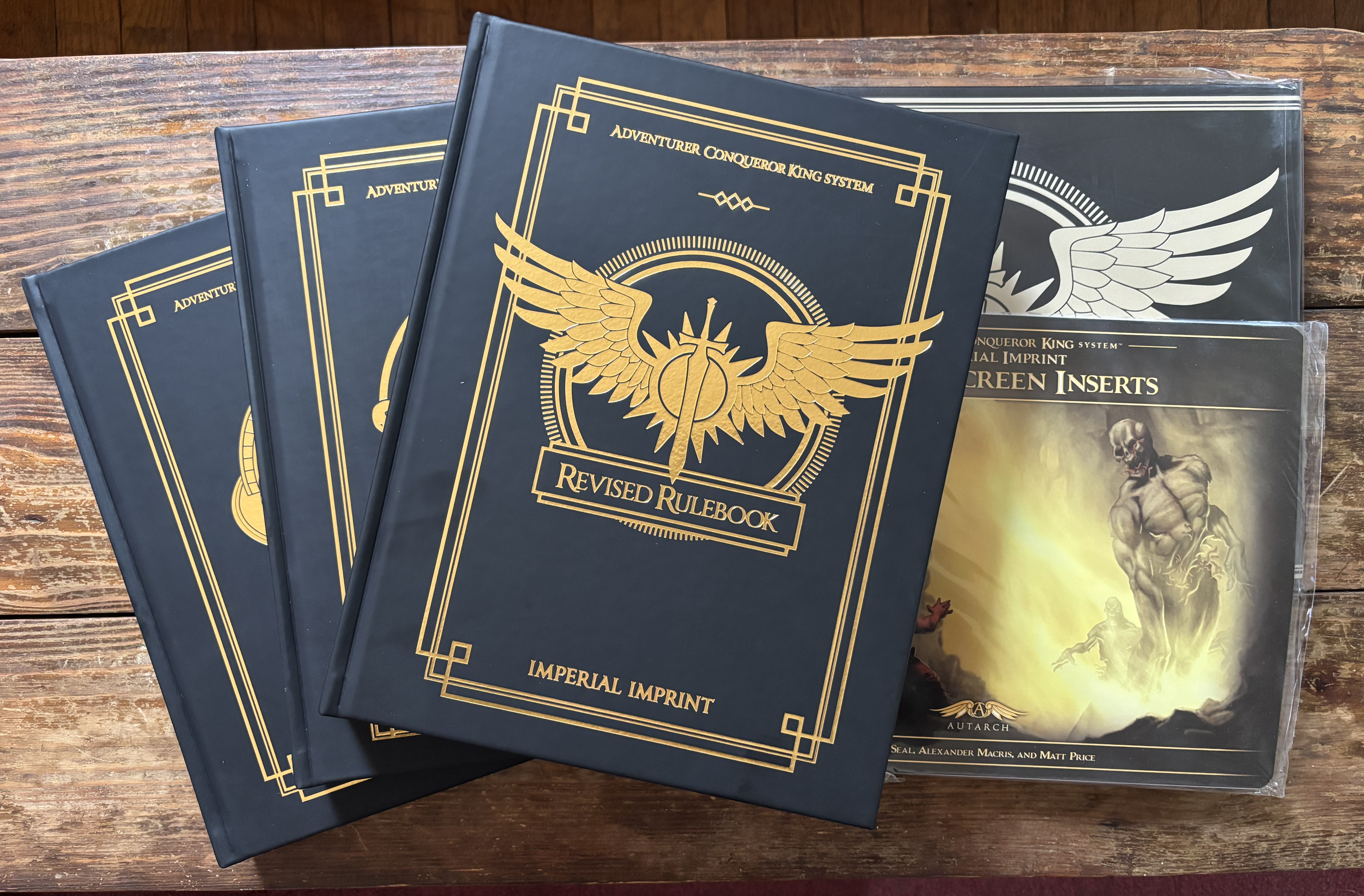
Adventurer Conqueror King System Imperial Imprint (ACKS II) by Alexander Macris (Autarch).

Talk about high quality books! 

These things are insane. This is about as comprehensive a version of B/X, BECMI as you will ever find.

The art is great (comic book style) some A.I. it seems; the theme: Imperial Rome.

This was the most I ever spent on a Kickstarter and I did so because the canceltards were pounding Macris quite hard. So a little support was in order. 

Anyhow, reports on these beauties will begin to pop up very soon. It's a lot to digest though.

Well done, Autarch.


Tuesday, April 8, 2025

I've Been Working On A System...


I was working on a new adventure and I like what I've done there (real dark!) but system mechanics have occupied my mind consistently for quite some time now.

I'm tired of being disappointed by games, even games I technically like or want to like. This always leads me to create my own stuff.

Too many house rules and you've created something else.

I wish the perfect system existed so I could just enjoy it.

And I'm certainly not creating it.

But what I'm making hits all the right buttons for me.

So far I have about 50 incomplete pages in progress (and that just in the last couple of weeks!) most of that is classes (around 30 right now). I have no idea when I'll finish it (end of the year? longer? probably longer) and I won't rush it, that's for sure, but this will be taking up the majority of my free time.

Thankfully I've got lots of art already drawn. No way I'm drawing all the monsters though.

What is it? I do have a simple but cool name for it. And that's a trick these days -- coming up with a name that no else has.

But what is it?

An amalgamation of D&D, Fighting Fantasy, and Traveller. 

Game on. 


Tuesday, February 18, 2025

Triggered Actions

2 claws/1 bite... iconic monster stat-line -- but, what if the bite attack did twice the listed damage and was only triggered if both claws hit? Obviously both claws have to hit the same target, like grappling and hug attacks. 

With if a dragon's breath weapon was only triggered on a critical hit? It would need a greater threat range than just 20, say 18/19-20 (20 would still be double damage.) Their breath weapon becomes an unpredictable bonus attack that occurs after all melee strikes are determined. And if multiple crits are rolled... prepare to burn!  

How about wizards getting a free spell if they score a 20 in combat? -- whether they have one available or not. Makes combat a little more exciting for magic-users. Same goes for spell-casting monsters or any monsters' special ability.

Suppose ghoul paralysis is only triggered on a bite (double listed damage) which in turn is only triggered if both claws hit? Makes paralysis less common, but more fun (it is a death sentence after all.)

The assassin's death strike triggered on a crit...? (Said that before, just saying it again.)

A medusa's gaze... Nobody fights medusas, you see statues, you run! Too fucking dangerous. What if her gaze (that's right, HER gaze, Woketards of the Coast) was triggered on her critical hits and your critical failures? 

Level drain, (the dreaded!)... again, make it triggered; 2 attacks, if both hit, then the classic -- grab you by the throat/kiss you/bite you/suck out your breath, whatever it is, followed by your preferred way to deal with energy drain.

Thieves get a pick-pocket check on a crit (if applicable) or a free back-stab, or a back-flip out of harms way, or hide-in-shadows (even if there aren't any!) They're just cool that way!

You see, crits should do more than just double damage.

How about a free attack if your crit slays? (This idea's certainly not new, but it is to someone.)

Clerics/paladins, when they score a crit vs chaos or undead, they (or their weapon) start(s) to glow with holy light and for the rest of the fight they do double damage (triple if another crit is scored, etc.) Who wouldn't enjoy that? It's bad-ass.

The barbarian's rage should be triggered, not planned -- a berserker can not control themselves! So, triggered by their own crit or a crit against them and then they fucking lose their shit! (They should also become a threat to allies while enraged.) If they want to fight the rage, they must roll under their wisdom score on a d20; same thing to end it. A crit on them also ends it.

Mechanics like this make the game more fun. They'll prompt more combats with monsters we've always avoided, and more combats period. Combat is FUN. It is not a failed state... unless you're a thief. 

The possibilities here are simple and numerous.

Tweak your games thus.


Thursday, January 9, 2025

Bringing In 2025 With "AD&D"

That is, AD&D, as in Adventures Dark and Deep by Joseph Bloch. Not new, just the newest form (originally three core books, now two.) One of the stalwart stewards of all things 1st Edition, Greyhawk in particular, Bloch created "AD&D" with the goal of doing what Gary would've done had he revised the game himself. As we know, Gary was booted before any such revision and the anti-Gygax 2nd Edition followed. Bloch brings new classes, like the Jester, Savant, Mystic, and Mountebank and new race choices including Centaurs, and of course, new spells and magic items, etc. Similar attempts have been made, such as, Trent Smith's Heroic Legendarium (a fine book) and OSRIC (more of an SRD) but I've seen nothing as comprehensive as what Bloch has done here.


Behold the size of these! Both are 500 page behemoths. Will the print-on-demand binding hold up? Such binding is weak enough on small books. My two original TSR books shown above are 40+ years old and the bindings are still perfect. I would've almost preferred soft-cover perfectly bound for these colossal tomes. I wonder what the cost would be to get them professionally bound?


The formatting is in the style of the later AD&D hardcovers (think Monster Manual II and Unearthed Arcana.) The art is mostly good and reminiscent of how it once was (black and white is best in life! Yes, color can be great, but look to companies like WoTC for what NOT to do! Jesus, WoTC sucks.) Anyhow, this bestiary has over 1000 entries, more than you'll ever need. It's like Monster Manuals III, and Fiend Folio all under one cover... and then some! Here, there are plenty of demons and devils and... angels (hell yeah!) and of course plenty of dragons. Curiously, no gold dragon -- replaced by the electrum? -- what is the story here?


Very nice Amazon. A level of boldness missing these days. Bold is good.


Add in the Book of Lost Tables and you have every random encounter table possible, mostly in the D1000 format. The best collection of random encounter tables that I've seen anywhere. And to simulate truly random, I've created a random table of these random tables. So I can randomly roll any monster in the game! I'm beginning to think that dungeons shouldn't be any more stratified than the wilderness. While traveling, you can encounter a dragon or a dryad regardless of your level. Although I'm as guilty as any one, there should be no "Dungeon for levels 3-5" there should simply be dungeons... enter at your own risk, anything is possible. The secret to explaining this... lots of empty spaces in between, plenty of empty (though not meaningless) rooms and long twisting corridors. No one will hear you scream... and no one will hear you fight! Nothing in reality is stratified for your safety and convenience. Although, yes, a certain logic does exist for the more dangerous foes being found the deeper you go. Still, I'm for much more randomized danger. I think I'll roll up a truly random dungeon and see what happens...

Pages upon pages of this!

It is (almost) exactly the game you think it is, though some subsystems have changed and there are more races and classes (the more classes the better!)  A small nitpick I have: The Assassin is presented as an "optional" class. Why? In a game where you can be chaotic-evil, murder, steal, raid, and ravage, where you can play a blackguard (the classic anti-paladin) the paragon of all things evil --which is not presented as "optional." Is an assassin worse than a blackguard? Castles & Crusades has also done this to assassins with their recent printings and they knew Gary well. Is this something he had in mind? Otherwise, I just don't get it. It's akin to making Greedo shoot first. Don't soften things up. Ever. That's a 2nd Edition sin.

Anyhow, these two massive tomes, with a side helping of random tables, are literally all you'd ever need to play this classic game... FOREVER.

Well done Joseph! 

Now people, ENTER DUNGEONS, LOOT AND SLAY!!!


Sunday, June 16, 2024

Signal Boost: Castles & Crusades Reforged!

This is going to be the 10th printing of the Castles & Crusades Players Handbook! (Along with reprints of the Castle Keepers Guide and Monsters & Treasure.)

You can thank the OGL debacle from last year. 

The Troll Lords are removing all content relating to the OGL. Mostly, things are being renamed, for example, alignment is now disposition. You might still be lawful good, but you'll either be LAWFULgood or lawfulGOOD, meaning you'll trend one way or the other. Many spells are being renamed, basically using synonymous terms, and/or rewritten/tweaked. And of course, certain monsters are getting a slight redesign with new, but similar, names.

Also of note, if you're familiar with the last printing of Monsters & Treasure, you know that it had what seems like a hundred different faerie creatures (all compiled from the various cultural codices) most of these are being removed and replaced with more mainstream monsters. I loved all of these faerie foes myself (their stat-blocks are vicious!) but I still have them, and they're reportedly being moved to future volumes more suited to their themes.

The rules are the same.

They even gave away a free PDF of the (in progress) Players Handbook.

I also believe they are switching to a less glossy white paper which is amazing news for our aging eyes!

So, do you need these new printings? No. If you're a C&C fan, do you want these? ABSOLUTELY. Also, if you're new to C&C or just curious, this is the perfect jumping on point.

Castles & Crusades is the closest thing I've seen to a modernized 1st edition AD&D, in play and esthetics.

Click the link below for the Kickstarter...

Castles & Crusades Reforged


Sunday, May 26, 2024

The Call Of Palladium...

A Cyber-Knight drawing her Psi-Sword... makes you wanna play doesn't it?


And so it calls, this crazy system of games from ages past and present.

The mother of all tool boxes.

The sum of all genres.

Rules upon rules, systems upon subsystems, flaws upon flaws, coolness that knows no bounds. A deep-dive is akin to an RPG acid-trip, you awake hours later on the floor, perfectly-bound soft-cover books and character sheets scattered about, your head ringing inside, police sirens in the distance... Is this the greatest system ever or the worst? Where have you been all this time? How many hours? How many days? To play this game straight or to hack? Hacking is a must. Contradictions and the fog of war demand it. But to pull one thread... does it unravel? No matter, down the rabbit hole you go. One thread at a time. Akin to reading the God Damn Necronomicon -- a sanity check will follow...

SYSTEM PSYCHOSIS...
  • Only one attack per round. Special maneuvers that use two attacks are made at -4. Full round actions are made at -8. OR... roll 2d20/3d20 and keep the worst. This also means higher level spells will take 2 or 3 rounds to cast. We could introduce a casting roll...
  • S.D.C./Hit points/A.R.. No M.D.C.!
  • O.C.C related skills are rolled randomly. A multitude of class-tailored charts are required, or one standard, weighted with precursors and bonuses (like below.) How much time do you have? And so, no spamming physical skills. Secondary skills are ignored. For example, the Cyber-Knight's O.C.C Related Skills list would read:

2 rolls on the Physical skills chart
3 rolls on the W.P. charts (3 rolls total between ancient and modern)
7 rolls on the chart below... (followed by rolls on the specifically rolled or chosen skill chart)

01-05  Communications
06-10  Cowboy (+10%)
11-15  Domestic
16-20  Electrical
21-25  Espionage (+5%)
26-30  Horsemanship (+10%)
31-35  Mechanical
36-40  Medical
41-45  Military (+5%)
46-50  Physical (+5%)
51-55  Pilot (+5%)
56-60  Pilot Related
61-65  Rogue
66-70  Science
71-75  Technical (+5%)
76-80  W.P. Ancient
81-85  W.P. Modern
86-90  Wilderness (+5%)
91-00  Choose

  • Weapon Proficiencies give a one-time bonus of +2 to strike/parry. If rolling randomly, you get a +2 every time you roll that weapon. This makes leveling up much simpler.
  • Rolling a percentile skill you already have gives you a bonus of 10%.
  • Paired Weapons roll 2d20 to attack. You can counter-strike, parry one, or both if also fighting with paired weapons.
  • All spells and psychic powers rolled randomly. More tables that don't exist, but could without too much work.
  • And speaking of tables... random tables for every single spell and magic item in the RIFTS Book of Magic and random tables for every single item listed in the Game Masters Guide. Every place you explore should produce random "somethings" to salvage and/or sell. A man can dream! Not impossible though...
  • Each skill based on the sum of two stats, e.g., Pick Locks starting percentage is the sum of I.Q. and Prowess. Perhaps +10. Lots of work, maybe too subjective. Not crucial. Not necessary. Probably simpler to start every skill at 30 or 35%. Most of them already do.
  • New skills should be less frequent, maybe 1 every 3 levels. Randomly rolled on your class chart like above. These are skills you are learning "off-screen" -- no need to explain. Perhaps have level-up instructions like 1 W.P. and 1 random skill. This way martial types will always improve combat in some way other than their hand-to-hand style. Or, add +1 to a W.P. of choice or roll randomly which results in +2 to whichever weapon skill is rolled.
  • When you level up add 5% to all skills... or roll 1d6 -- more time-consuming, but more interesting. Even if you've never used the skill, it's assumed you're using them "off-screen."
  • Hand-To-Hand styles are re-written to be more concise as to what you can and can not do and you CAN NOT trade up from Basic for a mere skill or two. 
  • Or... combine all combat bonuses and maneuvers onto one chart and depending on your O.C.C., you get so many rolls on this chart per level. So, in effect, everyone has their very own combat style. Something akin to this... 

01-05  +1 to strike/parry
06-10  +1 to dodge
11-15  +1 to roll with punch...
16-20  +1 to pull punch
21-25  +1 to disarm/entangle
26-30  +2 damage -- melee
31-33  +2 damage -- ranged
34-36  +1 crit range (e.g., 19-20)
37-38  K.O./stun on 20
39-40  Deathblow on 20
41-44  W.P. ancient (+1 to current or +2 to random new one)
45-48  W.P. modern (+1 to current or +2 to random new one)
49-51  +1 to initiative
52-54  +1 to perception
55-56  +1 save vs curses
57-58  +1 save vs Disease
59-60  +1 save vs poison
61-62  +1 save vs Drugs/toxins
63-64  +1 save vs Circles
65-66  +1 save vs horror
67-68  +1 save vs insanity
69-70  +1 save vs K.O./stun
71-72  +1 save vs spells/rituals
73-74  +1 save vs psionics
75-76  +1 save vs wards/fumes
77-78  +10% vs coma/death
79-81  +1 M.E.
82-84  +1 P.S.
85-87  +1 P.P.
88-90  +1 P.E.
91-93  +1 SPD
94-00  Choose

  • Bionic characters (Heroes Unlimited) roll bionics randomly and total value comes from that, which might determine how badly they want you back... are you hunted?
  • No difference between punches and kicks, all are strikes that do normal strike damage or power-strike damage (2 attacks, see above.) Can't have worlds where knights in plate-mail are walking around trying to karate-kick dragons.
  • Cyber-Knights' Psi-Swords start at 3d6 and crit on 19-20. Perhaps damage or bonus damage depends on the value of their M.E.?...or... they do 2d6 ignoring armor. They are PSI-Swords after all.
  • XP based on monster hit points and finding stuff. This incentivizes action and exploration, not "story-telling." Long live the OSR!
  • Critical Hits damage A.R. by one point. Death Blows by two.
  • Spell-casting penalty for wearing armor for each point of A.R. over 10. This is added to the target's save/dodge or subtracted from the caster's strike roll, whichever is appropriate.
  • "Mega-Damage" weapons simply get a multiplier: x5 or x10.
  • When all else fails, play the game exactly as it is... except... M.D.C. must go, and XP is as described above, and no spamming physical skills, and... you see, rabbit holes inside of rabbit holes.
  • And so on and on...
  • But seriously, the game is fine... except for M.D.C..


RIFTS Ultimate Edition is so crammed with information that every time you read it, it's like you never have. The only other book that does this is the original AD&D Dungeon Master's Guide. RIFTS is wildly overwritten and often contradictory. And that is why you get pulled down the rabbit hole. You can not escape the gravity of this. And, do you even want to? Despite the madness, you love it.

Is this the book I would take to an island?

The ultimate game exists here... somewhere.


Honoring Memorial Day: To those patriots who fought (and fight) for the stars & stripes, I salute you.


1E DMG: The Ultimate Dungeon Creator

What started out as a potential Act III for the module I'm working on has... expanded. 9 nearly full pages of old-school mega-mega-mega-...