
Not gonna say too much here, but, the Monsternomicon, is one of the best monster manuals ever made...


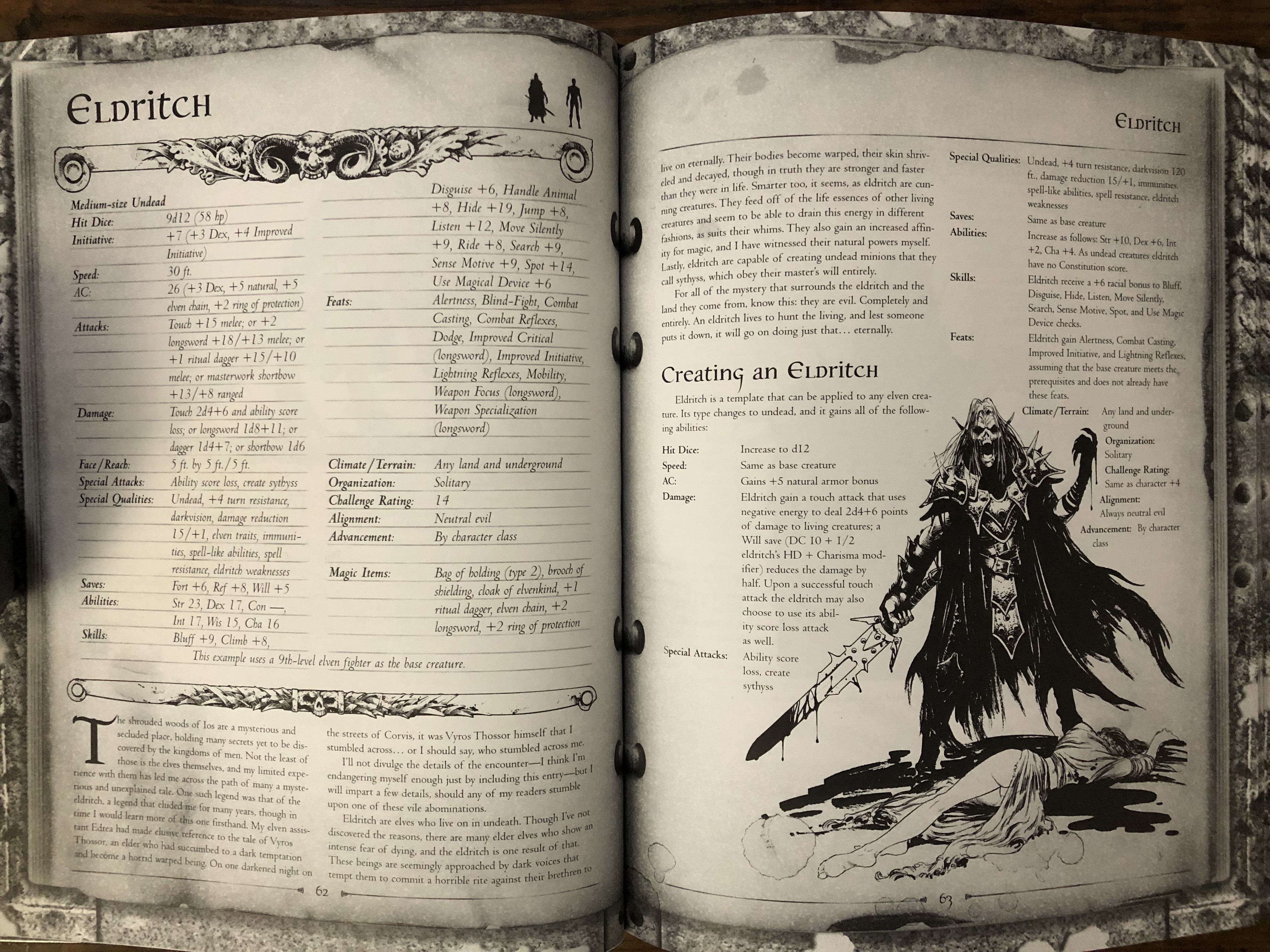


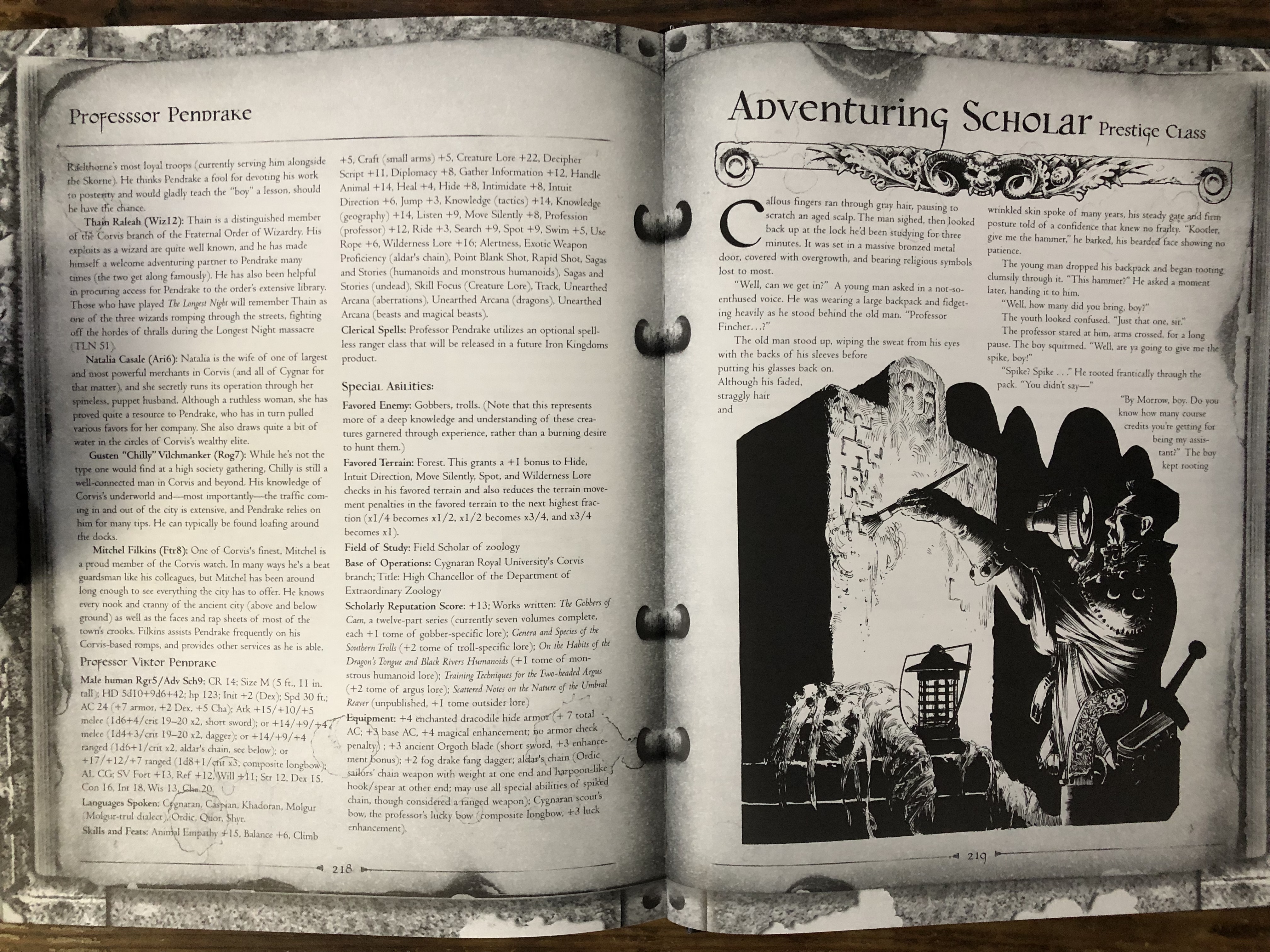
The art is superb.
The monsters are viscous.
The lore is awesome.
Iron Kingdoms is bad-ass.
Not gonna say too much here, but, the Monsternomicon, is one of the best monster manuals ever made...


Clerics are so uniquely D&D (which is the first place I even encountered the word cleric.)
Righteous warriors.
Bane of the undead.
Healers of pain.
Fanatics! Zealots!... At least there's the potential for such flavor.
So MEDIEVAL. Oh how modern D&D has forgotten (more likely -- abandoned/disowned) it's gritty medieval roots -- too European. (Actually D&D is a mixture of Medieval Europe and American Sword & Sorcery.)
I can't imagine D&D without clerics.
I want no part of D&D without clerics.
The MACE is their weapon. What better to crush bone? And as skeletons are the foot-soldiers of evil...
The undead... turn them you say? Suppose turning undead merely held them at bay, slightly cowering, as if from a bright flash of light, not destroy or cause them to flee. Kind of like the old Hammer Horror movies such a notion is actually based on where turning is usually something you do as you are trying to flee.
Suppose, clerics simply did more damage to undead. Double damage. And this can even increase with levels. So, they're still a weapon and undead are still a threat. In B/X, skeletons are made obsolete as soon as you have a 2nd level cleric... that's no fun.
In my imagination, clerics will always explicitly be a Roman Catholic styled class. I know, specialty priests and all that. And what of weird D&D, Dying Earth as opposed to Medieval Europe? Well you do you. But, I like having the Church, and demons, and witches, and black magic, and plagues, and crosses. All built on top of the ruins of the ancient, weird stuff...
Sects devoted Saints, Angels, Apostles...
And yes, CROSSES, not generic, good guy, holy-symbol crap. Actual crosses. And blood spilled in the name of those crosses. Wars and inquisitions. Saints and sinners. Heretics! There is a reason demi-humans live in the shadows of man... with some plotting their violent return.
And no spells. Spells are the realm of black magic (though some wizards may beg to differ, speaking of formulas and such.) Just prayers. And no spell books... Holy Missals.
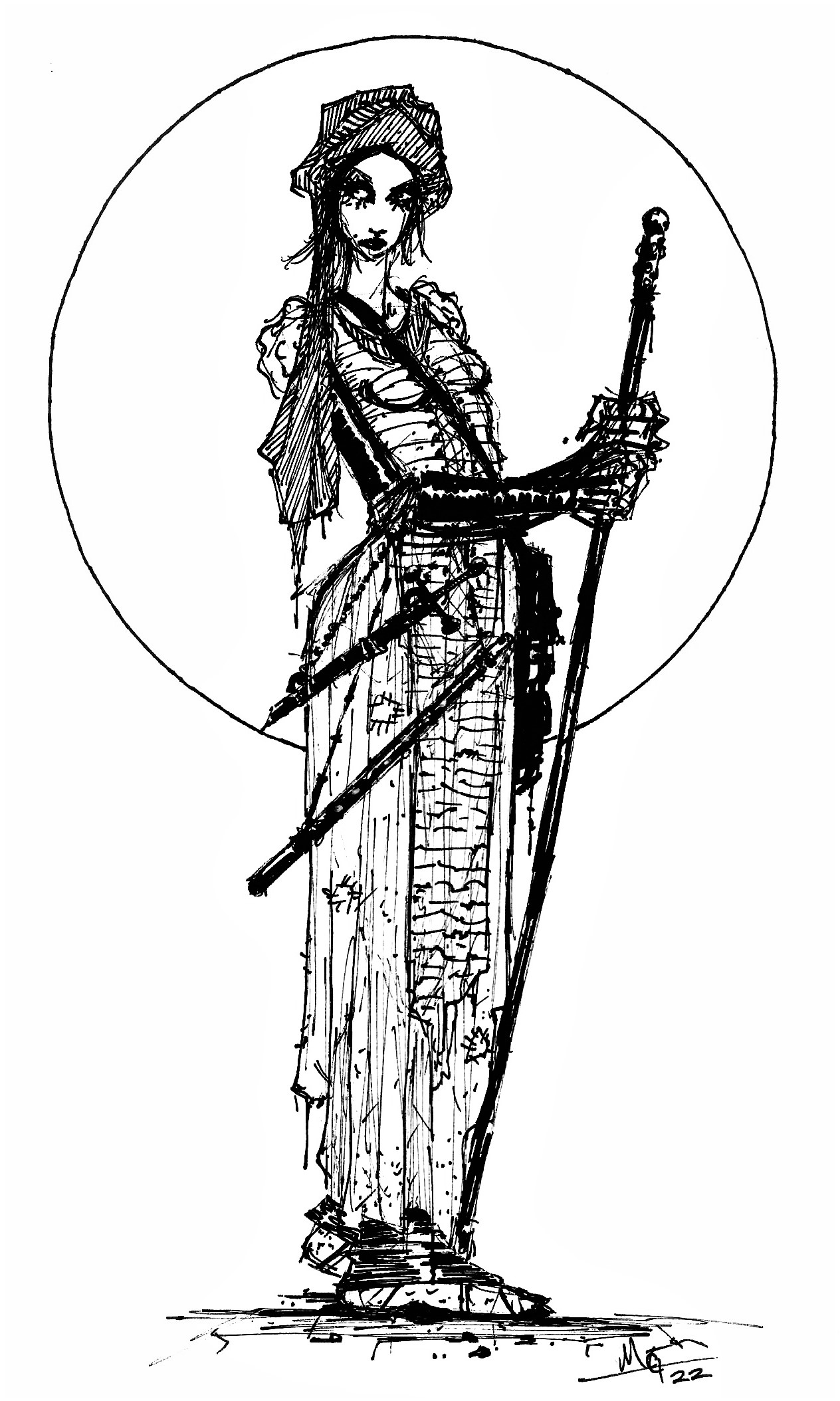
I love the concept of a squad of clerics, all clad in plate and chain, coifs are a must as well as a common tabard, delving deep to purge the unholy. A medieval crew, not unlike this book: VAMPIRE$.
The type of flavor, devotion, and fanaticism I want, Warhammer does better, Sisters of Battle and such. It is up to you to un-bland D&D.
Just some ruminations as I scratched pen to paper.

This was the beginning of the heart of my early D&D years (1987-1991). AD&D specifically.
In the first semester of the first year of high school, we all had the same lunch period (a half-hour labeled either A, B, or C.)
The same school at the same time as a certain rapper named Marshal.
The year was 1987. (I was introduced to the game back in 1983 with the Mentzer Red Box.)
Players ranged in number from 3-5 depending on the day. The main three consisted of a thief, a mage, and a cleric. I, of course, was the DM.
Now, there were no dice. This was the 80s, this was stealth mode. We weren't afraid of the, Satanic Panic, but we were afraid of being labeled dorks, so dice bouncing around the lunch room was out of the question. (There was a secret society aspect to D&D in the 80s that has been forever lost.)
I had a page full of dice-ranges written down, a few charts per die type, for example, there were three or four d20 tables that looked like this:
Dungeon Crawl Classics...
Gets an A+ for atmosphere.
When I should be writing/drawing adventures, the thing that burns my brain most is contemplating game mechanics. This contemplation is perpetual, no matter what goes on in life, the gears of game mechanics turn in the back of my mind. It's like music that never stops; a record that is broken. I have various clones of my own in progress that I'll never finish and I shouldn't even bother. They are not needed. I cringe when I see yet another heartbreaker announced.
House rules are all you need.
Every version of D&D, originals and clones, have at least one cool idea. I want all of those cool ideas to exist in the same game. Some games have many cool ideas, but are cursed with that one complete turd that ultimately turns you off.
It's like solving an unsolvable puzzle... or, if you solve it, you'll crack open the universe itself. Either way, it's only your solution, many others will not agree.
Just play the damn game right?
Anyhow...
DCC uses 3rd Edition's Fort, Reflex, and Will for it's saving throws. I like this, it really is the most refined of all the saving throw systems. The only flaw of this triad is that it doesn't feel archaic enough. I am however, not a fan of the DC (difficulty class) system, because the tendency of this system is that things get more challenging as you gain levels, when you should just be getting better at everything. It only works for me if you're running a true sandbox, where a 1st level thief might encounter a DC 25 lock and simply not be able to pick it. I prefer a version of Fort, Reflex, and Will that progresses in an old school fashion and have come up with such a system, as have others, I'm sure.
Thief skills use the same DC system as the saves. More and more, I've come full circle back to percentile based thief skills, though I do appreciate the simplicity of Lamentation's d6 skills. I'm not sure why, but percentiles have won me over, finally. Maybe it's because adding in critical successes and failures on doubles makes it just that bit more interesting, but I've also pondered turning each individual spell into it's own percentile skill...
Something else DCC imports from 3rd is multiple attacks (iterative attacks... which really is the Achilles Heal of 3rd) however here, they take the form of dice, such as d20/d20/d14. Better, but not may favorite part. Multiple attacks only work for me in singular man-to-man combat.
Where DCC clearly shines is spell-casting and overall atmosphere. The book almost comes across as a very large zine. Tables upon tables each speckled with neat little drawings. I recently lamented that HYPERBOREA lacked dragons and suggested they should have included a way to roll them up randomly, lo and behold, DCC has this exact thing. Major plus here. The same goes for demons. You want a name or a title, here's a d100 table. So many little tidbits that just make the book fun. The art varies from silly to serious, but definitely leans more silly. Yes, Gonzo is the goal here.
As I mentioned, spell-casting, is not quite Vancian. Full of flavor, full of risk, plenty of reward. Cast as many times as you want, depending on the results of the roll. Some successes could be a little more interesting than just more damage or more targets, but I appreciate the idea, that's for sure.
Stats are basically D&D's six renamed. Agility and Stamina will always ring as sci-fi to my ears and Personality is an unnecessary replacement for Charisma.
Not going to ramble here, this game's been out long enough that most people reading this are in the know, so here is my sheet. It's based off my B/X template and a few others. I tried to make it accessible for any class. The spell section may not even be needed as I'm sure players of this game print out their own spell-books.

Dungeon Crawl Classics Character Sheet

Robert E. Howard, Clark Ashton Smith, H.P. Lovecraft, these are the three main authors (among a few others) that Jeffrey P. Talanian's, HYPERBOREA, (formerly, Astonishing Swordsmen & Sorcerers Of...) seeks to emulate using a chassis that lies somewhere between B/X and AD&D.

Physically each book is a little over 300 pages (Player's Manual and Referee's Manual.) Both covers have this cool matte feel to them and the interior pages are cream colored, non-glossy and very easy to read. The layout is clean, well organized and full of art (some great, some not-so great.) Basically, these are nice books. (Personally, I would've preferred a single giant tome, like the 2nd Edition.)
Also pictured above is the soft-cover atlas of the HYPERBOREAN world -- which exists far into the future, is shaped like a planetary-sized hex, and orbits somewhere out near Saturn around a now dying, red sun. This is sword & sorcery for the most part, but there are elements of sword & science such as you see on the above Player's Manual cover and in the picture below. Obviously it's up to you if you want your knightly warrior to wield a ray-gun (aside from my own anomalous adventure, DATE OF EXPIRATION, it's usually not my thing) Setting aside, it's the system that I care most about...

And this system is fairly standard D&D -- classes, hit points, armor class, saving throws, Vancian-ish Magic, etc. The rules are not quite as basic as B/X, yet not as detailed as AD&D.
Where HYPERBOREA is neither basic or advanced, is how it handles races. Here, with the exceptions of Atlantean and Hyperborean (who are technically not humans) you only play as humans. The races are as follows:


At times you crave something wild, something guttural, primal, unbalanced and unapologetic. Something with a bit more crunch and art that doesn't remind you of Nickelodeon.
Then this arrives...

Real quick: HYPERBOREA -- Nice books! Well laid out with cream, non-glossy, very readable pages. I also ordered a copy of Against The Dark Master, not because I was ever into Rolemaster, but Darkmaster looks awesome too.
But more on those games another time (especially HYPERBOREA), as my mind drifted into this dark realm...


Deathstalkers II: The Fantasy Horror Role-Playing Game, by Mike Whitehead and Joe Meyers, (C) 1999-2005.
I've owned this book for perhaps, 10 years? I saw it at the game store several times before finally pulling the trigger. It was a massive, almost 700 page tome that seemed ridiculous, but I had to buy it, if only for its sheer size and NERVE. It has since sat idle in my collection.
Now, Deathstalkers II, is an interesting game. I would describe it as Palladium Fantasy meets D&D 3.0, with a touch of Warhammer. Seriously, imagine if Palladium never happened until Kevin Siembieda played D&D 3.0 and house-ruled the hell out of it. That is exactly, Deathstalkers II.
Like Palladium, there are many races to choose from, and many of these races have sub-races, so lots of choices. There are plenty of Half-Somethings, but no Half-lings...

Races are where you get your hit points and stat generation, in fact, race is legitimately, half your character. And like Palladium, you roll a different number of dice for different stats depending on your race, for example, minotaurs roll 7d6 for strength, 2d6 for intelligence, faeries only roll 1d4 for strength and constitution, etc. You won't see any 18 strength gnomes in this game! Stats use the 3rd Edition bonus progression, and if it wasn't clear already, 3rd Edition is the backbone of this game, e.g., saving throws are: Fort, Reflex, and Will.
NOTE: This is not WoTC/Disney. If you're looking for balance and harmony among your fantasy races, you won't find it here. Perhaps explore the radiant citadel.
Races have some class restrictions, suggested alignments, and just like Palladium, a listed chance for cannibalism, which is just a descriptive stat that implies a gritty game. Most races have 0% chance of cannibalism while orcs and bestial-minotaurs (there are three types of minotaurs) take the crown at 100%, with goblyns and half-demons coming in at 75% and 70% respectively.
Speaking of those half-demons, they are called the Antithrax. There's only one way an Antithrax comes into existence, and it's not implied like the half-orcs of old. This soulless race lives very bleak lives. The sample Antithrax picture below has hooves and a sword for an arm, but surprisingly, with all of the options in this book, there are no random tables here for rolling up your own unique demonic mutations...

Each race gets something called a Rage-Attack (which is optional) that they can use at the price of temporarily losing Constitution. It reminds me of a Capcom video game ability. For example, the Antithrax can open up a demon-pit of scorching flames around a nearby target doing 4d6 points of damage with no threat of actually igniting the victim. Fueling abilities with your stats, now that's a fascinating concept.
Below: A picture of a West-Lander Gnome. Poor little faerie. Faerie numbers are dwindling in this game world which might have something to do with the fact that eating faerie wings grants nice in-game benefits like granting extra spell castings, gaining 1d10 permanent new hit points, curing diseases, increasing ability scores, etc. You would never see something like this in a mainstream game.

Then we have the classes...

Here is a sample class chart...
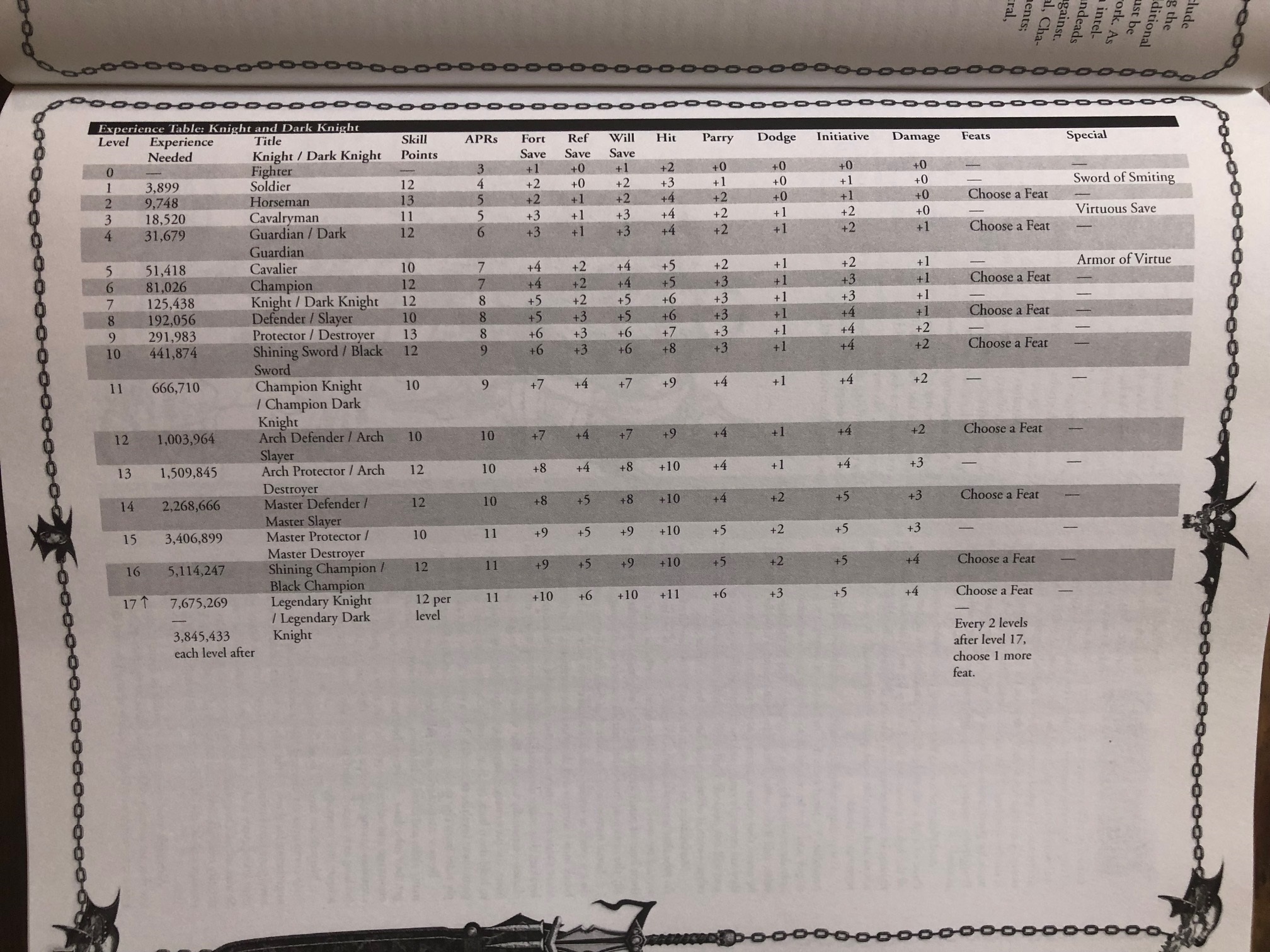
And some class art. The art in this book is a cool mixture of pencils and ink. Occasionally, there's a bad piece, but overall, it's pretty damn good.

Characters all start at level 0 and each class gets a certain amount of skill points and a list of preferred skills. They all start with 3 APRs (actions per round.) You get Hit, Parry, Dodge, Initiative, and Damage modifiers, and eventually Feats and Special Abilities. If you want to improve skills or feats before you level-up, you can spend XP to do so -- another interesting concept. Also, non spell-casters can spend XP to gain particular spells. This XP will be spent in the thousands, and, for Legendary Spells, millions!
Multiclassing exists as it does in 3rd Edition D&D, but with limits. Every class has a list of Class Exits, very much like in Warhammer.
There are a shit-ton of skills and feats, some of which are wild, giving you crazy combat benefits, but with a finite number of uses before you have to repurchase the feat, another cool concept. Some stand-out Feats...
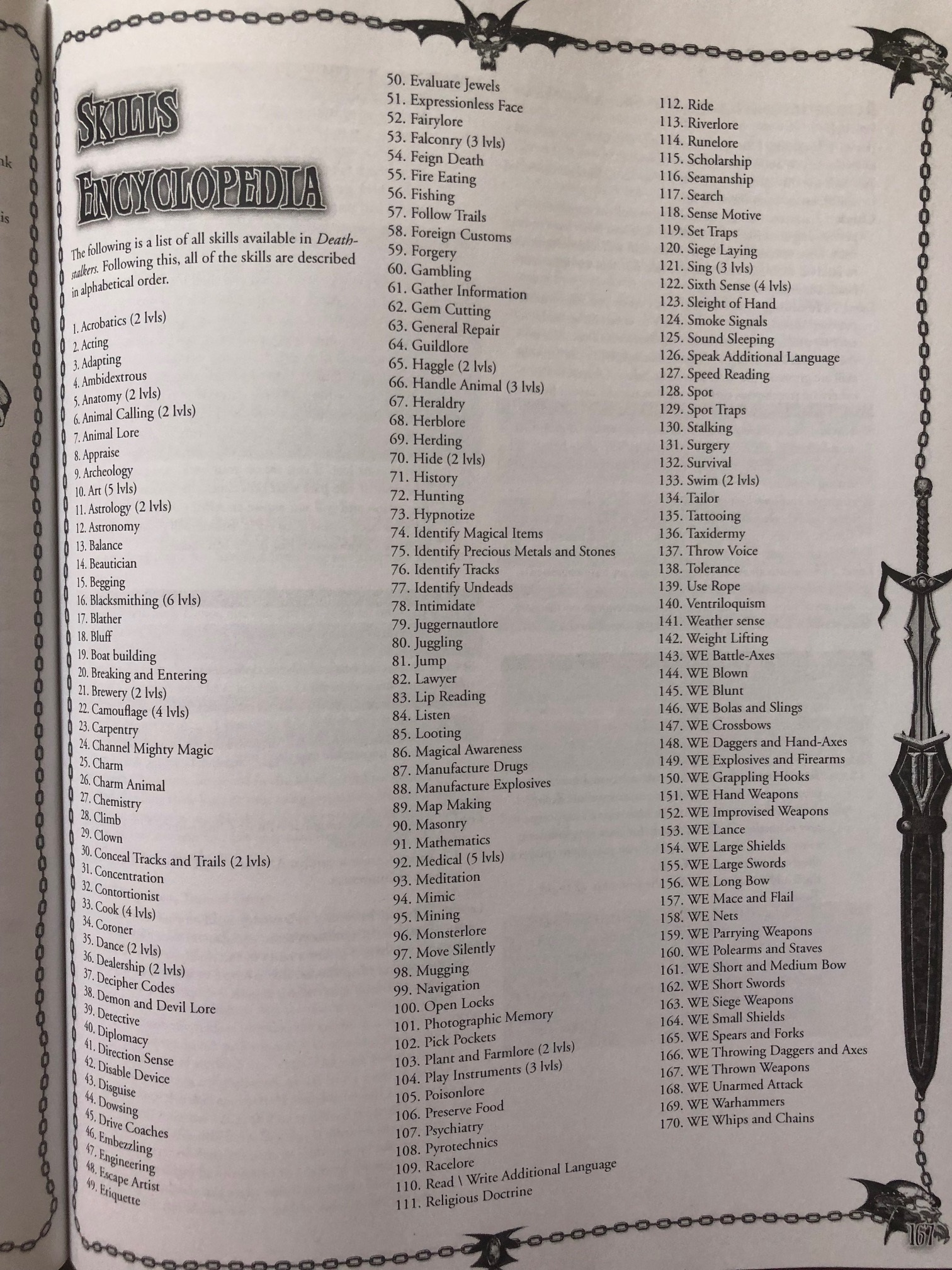

Combat is similar to Palladium's system, where-in you have a number of actions per round, spent, depending on what you want to do and what abilities/feats you might want to use. Melee attacks are parried and missile attacks are dodged. When you're out of actions, you can go into submissive defense mode where you can still parry (with limited effectiveness) but lose those actions on your next round, or you can take a mauling and hope your armor protects you, which... it won't. Armor is damage reduction, but not nearly enough. Shields add to your Parry score. There are many combat options if you want to use them.
There are over 500 spells in this book. Some new, some old with a different take. Magic-use is a spell-point system. You have X number of castings per day equal to half your Constitution score (keeping fractions) at 1st level and every level there-after. Some spell effects require spending multiple castings. Power Words & Ingredients reduce this cost -- pretty cool.

There are 5 dense pages of herbs and poisons, equipment lists are equally dense. Speaking of, if you want to be proficient in armor, you need to take the armor proficiency feat, regardless of your class, so you won't be wearing plate-mail for a while. Everyone starts out with fairly basic weapons and equipment and a handful of gold. Weapons are priced in the hundreds of gold pieces, e.g. a longsword is 565 GPs (Gpcs as listed in this game.) and damage is higher than you're used to, 2d6, 3d8, 3d10, 4d10, etc. Armor is priced in the high hundreds and well into the thousands. Everything has an availability score. It's a shame that D&D never used availability scores, there should be no guarantee of finding what you want in any particular town, which might give you reason to travel to the next one.

The game world is called, Arkastapha. The premise is one of lost beauty and a land ravaged by thousands of years of wars with Juggernauts -- ironclad golem-knights brought to life by dark Gods using the souls of the damned in the fires of the Dark Forge, and Demons (called Thraxians, once led by the Deathstalkers -- kind of like arch-demons, now in hibernation.) The usual monsters also exist, some with a new twist, and there are a fair number of them. Basically, think bleakness, scattered kingdoms. Points of light in a broken land. The mythology of it all is covered.


There's an edge to this game that I find refreshing and mechanics that are innovative.
Deathstalkers II: 700 pages of pure F*****G METAL!

The classic trope of the lone knight against a dragon. Is it doable in D&D? I've never seen it happen. Seems like a suicide mission unless you're talking about a super, high level, overpowered character, but where's the fun in that?
Before writing this, I watched the dragon fight scene in the Disney classic, Sleeping Beauty (1959). It's really the only on-screen visual I could think of that matches this scenario.
The Knight
Str:15(+1) Int:10 Wis:13(+1) Dex:10 Con:12 Cha:11
HP:36 AC:17(plate + shield) Dragon-Breath Save:10 To-Hit:+7 Damage:1d8+2
Magic Items:
Black Dragon
AC:17 HP:31 To-hit:+6 Damage: 2 claws (1d4+1), 1 bite(2d10), or 1 breath (current HP)
Morale:8 (will check at 16 and 8 hit points)
Round One (assumes no surprise)
Round Two
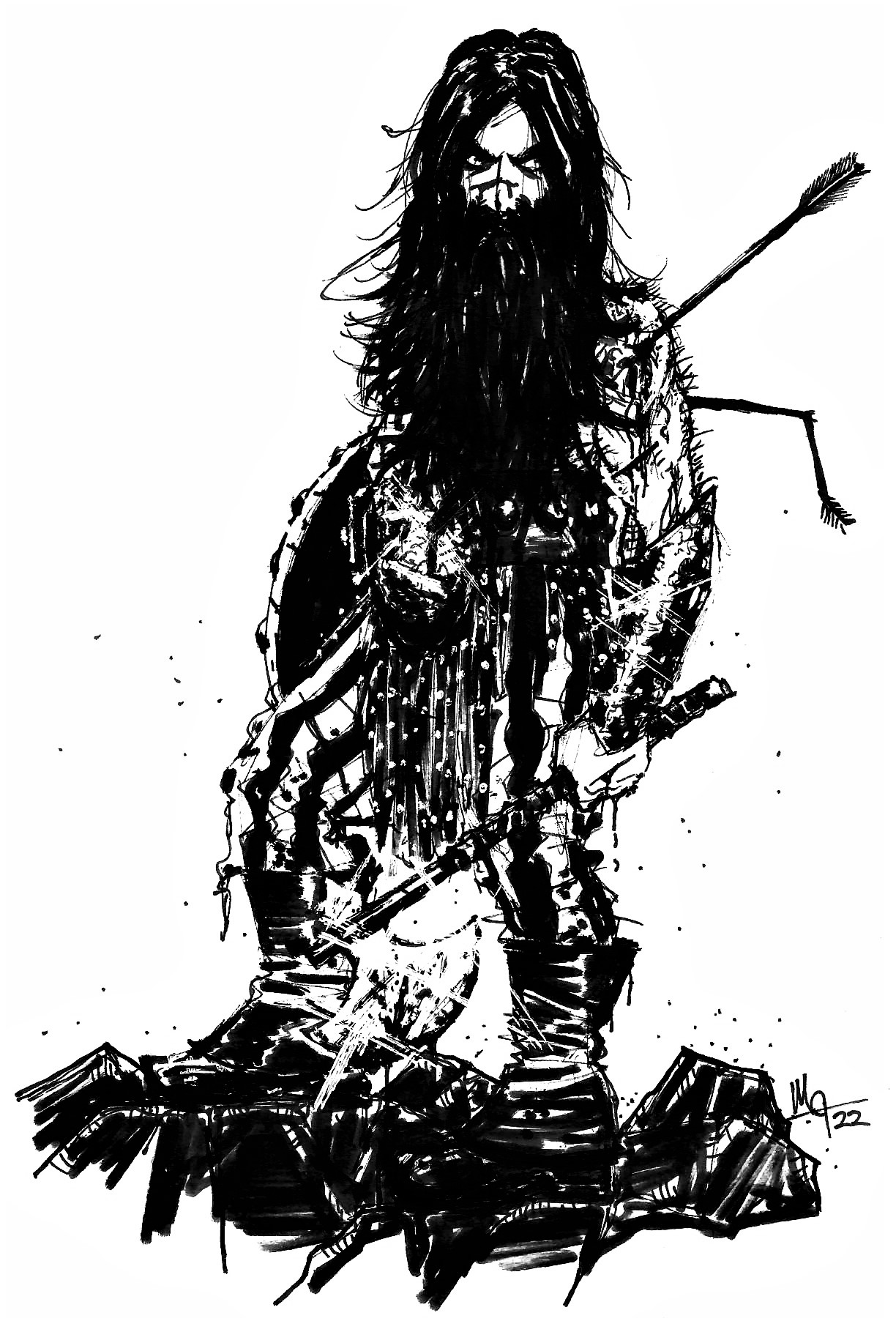
This comes up from time to time on forums, blogs, in person, everywhere. It's one of the age-old D&D questions.
The common response is usually something like this -- Hit points are a mixture of luck, endurance, and combat skill.
It's the inconsistencies that keep this question alive.
If it is luck, endurance, combat skill, and not "meat points" then why do smaller creatures have fewer hit points than larger ones? Is an elephant a luckier, more skilled combatant than a badger? A troll has far more hit points than a pixie. Pixies might be small and hard to hit, but once you "hit" them, they're dead. Seems like meat points to me.
You could interject here and say, shut up and enjoy the game (or even better -- play GURPS) and you would not be wrong. Just keep reading...
Hit points work just fine as meat points... until you have, say 100, 150, 300, etc. Then things get harder to justify. On a side note, I find it fascinating that with every new edition of the game, hit point bloat gets worse and worse. 4th Edition was the worst offender (at just about everything) but 5th Edition only dialed it back a little. Can these people not design a fun game without everything having hundreds and hundreds of hit points? Still trying to emulate fantasy computer games that ironically started off trying to emulate you...
When people concern themselves with the vagueness of hit points, what they actually crave, I think, is a bit of realism (though I use the word "realism" perhaps "grit" is the better term, because ultimately, there's nothing realistic here.)
They want to see blood. The more vague combat gets, the less fun it is. Players want to know, "Did my sword actually hit the ogre this time, or do I only get to actually hit the ogre when it dies?" When that minotaur scored a critical hit with it's massive battle-axe, what in actuality, just happened to me? Did he simply swing so close to my head that it rattled my nerves for 18 points of damage?
For those that argue for the luck/parry/endurance explanation, is it really "realistic" to say that the only time you actually get hit in violent, medieval combat, is when you suffer the killing blow? Is that even fun? Then again, to be fair, that crowd is not aiming for realism or grit. Of course this is further convoluted by the fact that the length of the combat round varies over the editions from 6 seconds to 1 minute, and a lot of things can happen in 1 minute. But... that doesn't mean that at the end of that round, when you've taken a hit, that you haven't actually taken a "hit."
We've all exhausted this topic, yet the hobby will never be done with it. Simulationist vs gamist, sport vs war...
I've always been very descriptive with combat. I like a "hit" to be a "hit." Which is probably why I like opposed combat rolls and parry options.
If you've been "hit" by an arrow, then you've been HIT by an arrow! Sword & Sorcery fiction and imagery is packed full of heroes carrying on the fight with arrows sticking out of them. It's almost a trope. It's easy to explain too, because often arrows don't penetrate that deep or hit vital organs, and if you have any kind of armor on, it's even easier still, because it's mostly stuck in the armor.
The same can be said of weapon hits. Yes, you did actually just take a hit from that guy's battle-axe, but he didn't lop your head off, or your hand for that matter. You've been cut, you are bleeding... a bit, you are losing hit points and yes an elephant does have more hit points than you because it can physically survive more hits from that axe than you. But, you're tough, gritty, you're a pulp hero, you can take it! It's simply not necessary to say that you've been dodging and parrying and weaving in and out of blows, or you're just plain lucky. No! Your ass just got stabbed! Now fight on! This is the bread and butter of pulp fiction.
So... what happens when you fail your saving throw against something like a dragon's breath weapon? Mr. pulp hero just took the full brunt of 37 points of damage from a blast of fire and only has 3 hit points left. Those that made their save only took half damage, they merely got singed as they dove for cover. Not you...
What does that look like?
It should look like something "permanent" if you ask me. You have most certainly suffered serious burns. If the undead leave lasting effects from their touch, iconic attacks like dragon breath should do the same, and at the moment, I suggest 1 point lost from a random ability per 15 points of dragon breath damage taken on a failed save. There's a touch of grit for ya. You can even apply this principal to critical hits and level drain, but in those cases I would only make it 1 point lost in total and perhaps only after a failed death save.
So, you might level up and get better at what you do, but your body is taking a beating and showing the scars. That's a simple way to add some realism or "grit" to your game (and panic not, my friends, dungeons are full of ability-raising tricks!) Also, with realism in mind, "system-shock" rules should not be ignored.
As you gain levels, you do gain more damage resilience and the ability to avoid the killing blow. This is the endurance and combat savvy aspect of hit points. Regardless, when you've been hit, you are taking actual damage.
On a bit of a tangent, the size of dragons has also gotten out of control. They're iconic and they should be dangerous, but they're not Godzilla. If a lone, valorous knight is expected to have a chance...
Also, speaking of dragon breath, we all know the house rule, "Shields shall be splintered," well, they shall be "melted" too:
Clearly, your characters aren't going to lose limbs, but they will be cut and bitten and torn and burned... they will be scarred, and yet, the mythical underworld calls... again and again.
You're not playing village wimps.
What started out as a potential Act III for the module I'm working on has... expanded. 9 nearly full pages of old-school mega-mega-mega-...

