Wednesday, September 28, 2022

Dungeon Crawl Classics Character Sheet


I haven't played this system. I bought it more out of curiosity than anything else, last year or two I think. It was/is popular, so I noticed, so maybe there was a reason for that. Like many others out there, the Zocchi Dice turned me off, almost repulsively so, especially the d5 and d7, it's like they are physical manifestations of Non-Euclidian geometry. They are totally pointless. The d16/d24, even the the d30, I could see uses for.

Dungeon Crawl Classics...

Gets an A+ for atmosphere.

When I should be writing/drawing adventures, the thing that burns my brain most is contemplating game mechanics. This contemplation is perpetual, no matter what goes on in life, the gears of game mechanics turn in the back of my mind. It's like music that never stops; a record that is broken. I have various clones of my own in progress that I'll never finish and I shouldn't even bother. They are not needed. I cringe when I see yet another heartbreaker announced.

House rules are all you need.

Every version of D&D, originals and clones, have at least one cool idea. I want all of those cool ideas to exist in the same game. Some games have many cool ideas, but are cursed with that one complete turd that ultimately turns you off.

It's like solving an unsolvable puzzle... or, if you solve it, you'll crack open the universe itself. Either way, it's only your solution, many others will not agree.

Just play the damn game right?

Anyhow...

DCC uses 3rd Edition's Fort, Reflex, and Will for it's saving throws. I like this, it really is the most refined of all the saving throw systems. The only flaw of this triad is that it doesn't feel archaic enough. I am however, not a fan of the DC (difficulty class) system, because the tendency of this system is that things get more challenging as you gain levels, when you should just be getting better at everything. It only works for me if you're running a true sandbox, where a 1st level thief might encounter a DC 25 lock and simply not be able to pick it. I prefer a version of Fort, Reflex, and Will that progresses in an old school fashion and have come up with such a system, as have others, I'm sure.

Thief skills use the same DC system as the saves. More and more, I've come full circle back to percentile based thief skills, though I do appreciate the simplicity of Lamentation's d6 skills. I'm not sure why, but percentiles have won me over, finally. Maybe it's because adding in critical successes and failures on doubles makes it just that bit more interesting, but I've also pondered turning each individual spell into it's own percentile skill...

Something else DCC imports from 3rd is multiple attacks (iterative attacks... which really is the Achilles Heal of 3rd) however here, they take the form of dice, such as d20/d20/d14. Better, but not may favorite part. Multiple attacks only work for me in singular man-to-man combat.

Where DCC clearly shines is spell-casting and overall atmosphere. The book almost comes across as a very large zine. Tables upon tables each speckled with neat little drawings. I recently lamented that HYPERBOREA lacked dragons and suggested they should have included a way to roll them up randomly, lo and behold, DCC has this exact thing. Major plus here. The same goes for demons. You want a name or a title, here's a d100 table. So many little tidbits that just make the book fun. The art varies from silly to serious, but definitely leans more silly. Yes, Gonzo is the goal here. 

As I mentioned, spell-casting, is not quite Vancian. Full of flavor, full of risk, plenty of reward. Cast as many times as you want, depending on the results of the roll. Some successes could be a little more interesting than just more damage or more targets, but I appreciate the idea, that's for sure.

Stats are basically D&D's six renamed. Agility and Stamina will always ring as sci-fi to my ears and Personality is an unnecessary replacement for Charisma.

Not going to ramble here, this game's been out long enough that most people reading this are in the know, so here is my sheet. It's based off my B/X template and a few others. I tried to make it accessible for any class. The spell section may not even be needed as I'm sure players of this game print out their own spell-books. 

Sample

Dungeon Crawl Classics Character Sheet


Saturday, August 20, 2022

And Now... HYPERBOREA! Plus Character Sheet...

A Shaman I rolled up

Robert E. Howard, Clark Ashton Smith, H.P. Lovecraft, these are the three main authors (among a few others) that Jeffrey P. Talanian's, HYPERBOREA, (formerly, Astonishing Swordsmen & Sorcerers Of...) seeks to emulate using a chassis that lies somewhere between B/X and AD&D.


This is technically the third edition of this game which was first published as a box set in 2013, then as a massive hardback tome in 2017. I own neither of those two editions, though, I was aware of them. By the time this game really captured my attention, the first two editions were out of print and rare. I had managed to view a PDF of the 2nd edition (back when such a thing was easier) and what stuck in my head were these cool pencil sketches... more on that below. A perfectly-bound, paperback Player's Manual, also came into existence not too long ago, which I was all set to buy, when I discovered that a 3rd edition was imminent. That 3rd edition kickstarted about a year ago, the result of which are the handsome books you see above.

Physically each book is a little over 300 pages (Player's Manual and Referee's Manual.) Both covers have this cool matte feel to them and the interior pages are cream colored, non-glossy and very easy to read. The layout is clean, well organized and full of art (some great, some not-so great.) Basically, these are nice books. (Personally, I would've preferred a single giant tome, like the 2nd Edition.)

Also pictured above is the soft-cover atlas of the HYPERBOREAN world -- which exists far into the future, is shaped like a planetary-sized hex, and orbits somewhere out near Saturn around a now dying, red sun. This is sword & sorcery for the most part, but there are elements of sword & science such as you see on the above Player's Manual cover and in the picture below. Obviously it's up to you if you want your knightly warrior to wield a ray-gun (aside from my own anomalous adventure, DATE OF EXPIRATION, it's usually not my thing) Setting aside, it's the system that I care most about...

And this system is fairly standard D&D -- classes, hit points, armor class, saving throws, Vancian-ish Magic, etc. The rules are not quite as basic as B/X, yet not as detailed as AD&D. 

Where HYPERBOREA is neither basic or advanced, is how it handles races. Here, with the exceptions of Atlantean and Hyperborean (who are technically not humans) you only play as humans. The races are as follows:

  • Common
  • Amazon
  • Atlantean
  • Esquimaux
  • Hyperborean
  • Ixian
  • Kelt
  • Kimmerian
  • Kimmer-Kelt
  • Pict
  • Pict (Half-Blood)
  • Viking
  • Anglo-Saxon
  • Carolingian Frank
  • Esquimaux-Ixian
  • Greek
  • Lapp
  • Lemurian
  • Moor
  • Mu
  • Oon
  • Roman
  • Tlingit
  • Yakut
Most of you will have a fair idea of the gist of these races (from Howard, Smith, etc.) And though there are plenty of tables to determine your character's height, weight, eye color, hair color, complexion, age, and name, your race offers ZERO actual in-game benefits, even if you're playing an Atlantean or Hyperborean. Race is merely a descriptor, fluff. This is BORING (especially after reviewing Deathstalkers) but I get it: Beware the woke twitter mob. State that one type of human is better at something than another, even in a FANTASY setting, and all Hell breaks loose. 

Of course, there's nothing from stopping you from adding Demi-Humans and/or bonus/penalties to your HYPERBOREAN game...

Classes. If you love lots of classes (and I love lots of classes) you'll be happy: 4 main classes with 22 sub-classes (some of the names though... ugh!)
  • Fighter
    • Barbarian 
    • Berserker 
    • Cataphract (Need eye surgery? Knight would be better)
    • Huntsman (Hunter is better)
    • Paladin (Champion perhaps? Seems like sword & sorcery has Champions)
    • Ranger
    • Warlock
  • Magician
    • Cryomancer
    • Illusionist
    • Necromancer
    • Pryomancer
    • Witch
  • Cleric
    • Druid
    • Monk
    • Priest
    • Runegraver
    • Shaman
  • Thief
    • Assassin
    • Bard
    • Legerdemainist (thief/magician) --who wants to say this? (how about Trickster?)
    • Purloiner (thief/cleric, Cultist or Zealot is better)
    • Scout
These classes are generally well designed and do pretty much what you'd want them to. Occasionally, there's a fluff ability, like horsemanship or survival, which are only as useful as the DM wants them to be. I will always prefer actual mechanics.

Classes are listed to level 12. They all have the same single saving-throw progression, staring at 16 and improving by 1 every other level to 11 at 12th level. So, even at 12th level, your saves will only hover around 50%, which is kind of rough for a seasoned sword & sorcery protagonist. Each class also receives two +2 bonuses to specific saves, which are the classic five renamed to:
  • Death
  • Transformation
  • Device
  • Avoidance
  • Sorcery
Dexterity can also improve Avoidance, and Constitution and Wisdom can improve specific situations like poison and willpower, respectively. So, the saving throw system is an amalgamation, ranging from a single save to five and beyond.

Your "to-hit" bonus is called fighting and progresses logically, as opposed to the weird progression of B/X.

Armor Class is descending. Easily fixed if not your thing.

Also, medium and heavy armors offer a bit of damage resistance, 1 or 2 points.

Attribute checks, called tests are done on 1d6 and are primarily based on the classic open doors mechanic. These are things such as opening stuck doors, balancing on a beam, or swimming across a lake. There are also extraordinary feats which are based on the old bend bars/lift gates mechanic, a % roll. Tougher challenges, lower rates of success. Mental attributes do not have tests or feats as the author deems there are too many variables to consider.

The optional concentration check for spell-casters is very cool: If you take damage while casting, roll 3d6 + damage taken. If you roll under your casting attribute score (intelligence or wisdom) your spell succeeds, otherwise, not.

One thing HYPERBOREA does take from AD&D is multiple attacks per round in the form of 3/2 at 7th level for fighters. This can improve to 2/2 and 5/2 with weapon/grand mastery (depending on the weapon.) For the uninitiated, 3/2 means two attacks every other round. This was always clumsy in practice, in my experience. Just give them 2 attacks, then 3, and be done with it. Or give them a damage bonus, or both of these things. Forget the fractions.

Some other thoughts...
  • Thieves are better at finding secret doors than everybody else... why haven't I seen that before? Thief skills use the d12 and they start out fairly competent. Actually, the d12 gets a lot of love in HYPERBOREA.
  • Witches' are very "witchy," they brew things, make effigies, have useful familiars and actually ride brooms! -- eventually.
  • Priests get more spells than any other class.
  • Clerics use spells like magicians do, meaning, all spells of a level aren't available to them.
  • Fighters are fairly lame, as usual, sure they get multiple attacks vs 1 HD foes, so they'll kick-ass if you're only fighting orcs (btw, HYPERBOREAN orcs are unabashedly EVIL, this game gets my vote for that alone.) Cleave/damage bonus/carry-over damage would be better, again, easy to house-rule these types of things.)
  • Huntsman, Ranger, and Scout are kind of similar.
  • The Runegraver seems more like a concept class that would appear in someone's zine.
  • The Shaman is exactly what a Shaman should be. Very well done here.
  • Assassins have to jump through one-too-many hoops to assassinate someone. I love assassins, don't gimp them.
  • The Warlock is basically the Elf (designed better) if you wanted to play one.  
  • Assassins, Huntsmen, and Shamans can harvest venom from slain monsters. Anyone else can try, but these classes are much better at it. Very cool, but it's a static ability that oddly doesn't increase with levels.
  • Simple Alchemy rules exist to brew potions, decoctions, and poison, for most spell-casters. Also very cool.
  • Tactical combat options exist, though I feel they would mostly be ignored (or abused.) Examples are shield-bash, pommel strike, two-weapon fighting. Some are cool though.

Art is important to me...

Questionable decisions were made with art in this version, which represents a step back. Thankfully, Ian Baggley's awesome sketches still remain, if not front and center, where they belong.

Baggley Barbarian

Baggley Berserker

Baggley Warlock

Baggley Shaman

Baggley Bard (coolest Bard I've ever seen)

The Monsters...

No dragons. Kind of weird, as dragons do exist in sword & sorcery, but... ok, they're easy to add. I understand not wanting D&D's chromatic dragons, but random tables to determine dragon color, breath, HD, and other abilities would have been cool, sort of a "create your own dragon" type of thing. Otherwise, HYPERBOREA has one of the best done bestiary sections out there. Good art, good write-ups, a bit of grit (these are not WoTC/Disney monsters.) Stat blocks have the perfect balance of information. I do, however, have one complaint: There are no random encounter tables. What?!? 

Nice Succubus! (But they don't drain levels or stats, why not?)

Magic Items and spells are a combination of the usual fare with new additions. Recognize this?

Round here we call this a Glaive

HYPERBOREA's a solid game which strikes a nice balance between simplicity and detail. It definitely evokes that sword & sorcery feel and if the I.P. wasn't so closely guarded (which I understand) it could easily contend with OSE as the go-to system for many. All-in-all, an excellent game with some cool ideas that make you wonder, why didn't I think of that? 

And here is the character sheet I made for it. The official character sheet is alright, but you know me... 

HYPERBOREA Character Sheet


Saturday, July 23, 2022

Deathstalkers II: 700 Pages Of Pure METAL!

At times you crave something wild, something guttural, primal, unbalanced and unapologetic. Something with a bit more crunch and art that doesn't remind you of Nickelodeon.

Then this arrives...

Real quick: HYPERBOREA -- Nice books! Well laid out with cream, non-glossy, very readable pages. I also ordered a copy of Against The Dark Master, not because I was ever into Rolemaster, but Darkmaster looks awesome too.

But more on those games another time (especially HYPERBOREA), as my mind drifted into this dark realm...


Deathstalkers II: The Fantasy Horror Role-Playing Game, by Mike Whitehead and Joe Meyers, (C) 1999-2005.

I've owned this book for perhaps, 10 years? I saw it at the game store several times before finally pulling the trigger. It was a massive, almost 700 page tome that seemed ridiculous, but I had to buy it, if only for its sheer size and NERVE. It has since sat idle in my collection.

Now, Deathstalkers II, is an interesting game. I would describe it as Palladium Fantasy meets D&D 3.0, with a touch of Warhammer. Seriously, imagine if Palladium never happened until Kevin Siembieda played D&D 3.0 and house-ruled the hell out of it. That is exactly, Deathstalkers II.

Like Palladium, there are many races to choose from, and many of these races have sub-races, so lots of choices. There are plenty of Half-Somethings, but no Half-lings...

Races are where you get your hit points and stat generation, in fact, race is legitimately, half your character. And like Palladium, you roll a different number of dice for different stats depending on your race, for example, minotaurs roll 7d6 for strength, 2d6 for intelligence, faeries only roll 1d4 for strength and constitution, etc. You won't see any 18 strength gnomes in this game! Stats use the 3rd Edition bonus progression, and if it wasn't clear already, 3rd Edition is the backbone of this game, e.g., saving throws are: Fort, Reflex, and Will.

NOTE: This is not WoTC/Disney. If you're looking for balance and harmony among your fantasy races, you won't find it here. Perhaps explore the radiant citadel.

Races have some class restrictions, suggested alignments, and just like Palladium, a listed chance for cannibalism, which is just a descriptive stat that implies a gritty game. Most races have 0% chance of cannibalism while orcs and bestial-minotaurs (there are three types of minotaurs) take the crown at 100%, with goblyns and half-demons coming in at 75% and 70% respectively. 

Speaking of those half-demons, they are called the Antithrax. There's only one way an Antithrax comes into existence, and it's not implied like the half-orcs of old. This soulless race lives very bleak lives. The sample Antithrax picture below has hooves and a sword for an arm, but surprisingly, with all of the options in this book, there are no random tables here for rolling up your own unique demonic mutations...

Each race gets something called a Rage-Attack (which is optional) that they can use at the price of temporarily losing Constitution. It reminds me of a Capcom video game ability. For example, the Antithrax can open up a demon-pit of scorching flames around a nearby target doing 4d6 points of damage with no threat of actually igniting the victim. Fueling abilities with your stats, now that's a fascinating concept.

Below: A picture of a West-Lander Gnome. Poor little faerie. Faerie numbers are dwindling in this game world which might have something to do with the fact that eating faerie wings grants nice in-game benefits like granting extra spell castings, gaining 1d10 permanent new hit points, curing diseases, increasing ability scores, etc. You would never see something like this in a mainstream game.

Then we have the classes...

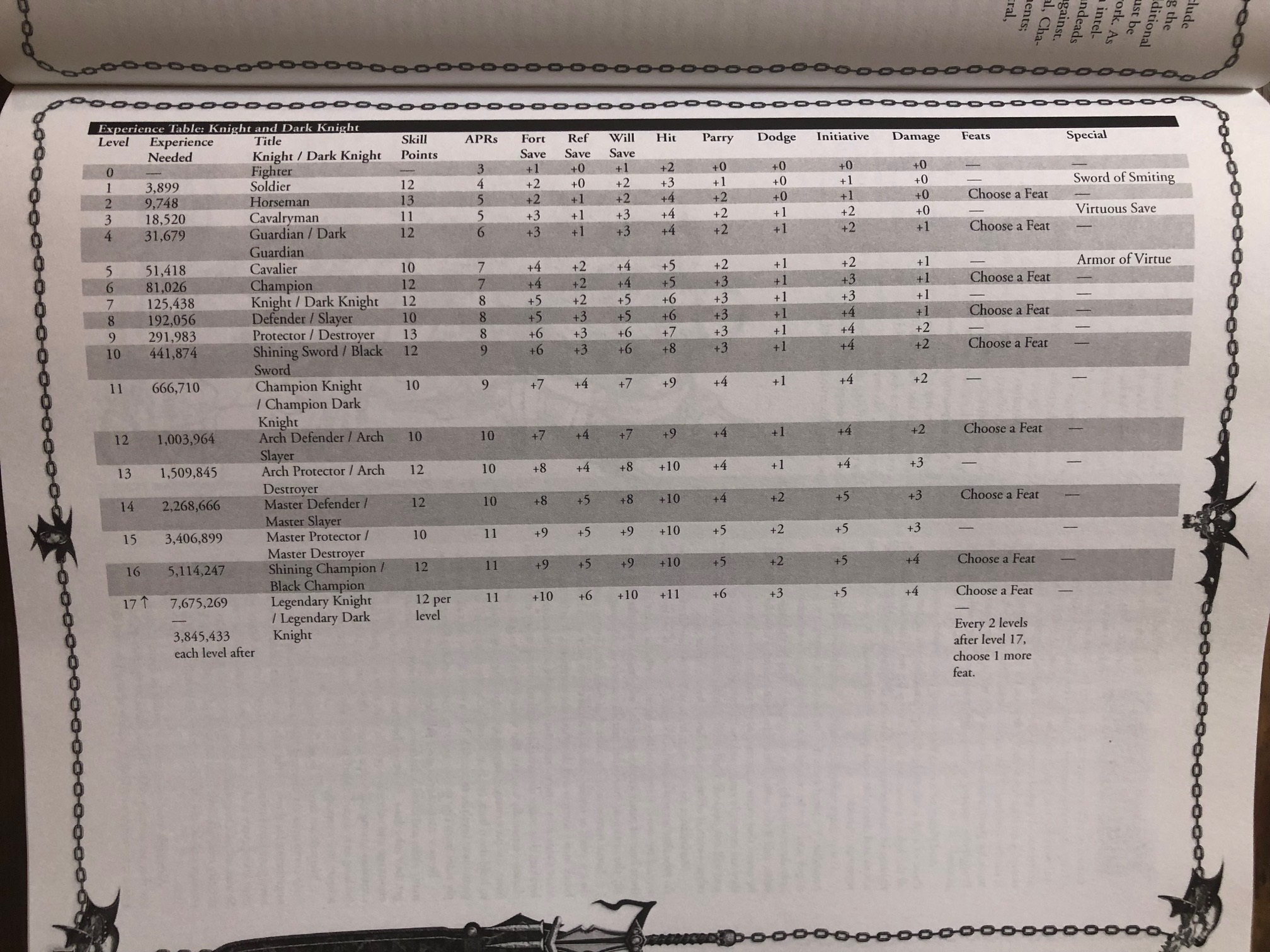
Here is a sample class chart...

And some class art. The art in this book is a cool mixture of pencils and ink. Occasionally, there's a bad piece, but overall, it's pretty damn good.

Characters all start at level 0 and each class gets a certain amount of skill points and a list of preferred skills. They all start with 3 APRs (actions per round.) You get Hit, Parry, Dodge, Initiative, and Damage modifiers, and eventually Feats and Special Abilities. If you want to improve skills or feats before you level-up, you can spend XP to do so -- another interesting concept. Also, non spell-casters can spend XP to gain particular spells. This XP will be spent in the thousands, and, for Legendary Spells, millions!

Multiclassing exists as it does in 3rd Edition D&D, but with limits. Every class has a list of Class Exits, very much like in Warhammer.

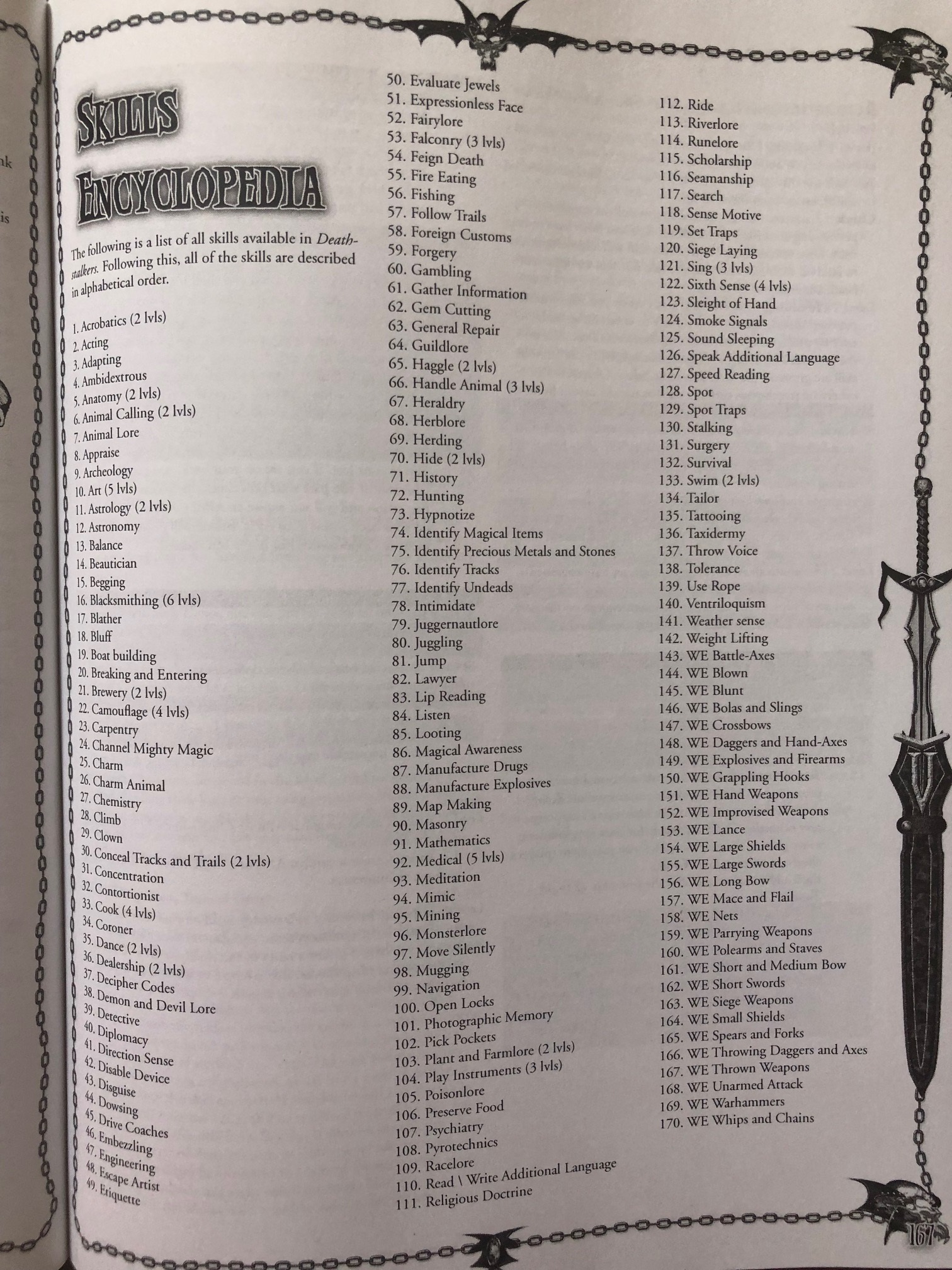
There are a shit-ton of skills and feats, some of which are wild, giving you crazy combat benefits, but with a finite number of uses before you have to repurchase the feat, another cool concept. Some stand-out Feats...

  • Aggressive Assault (I-X): One use per round, roll your Aggressive Assault damage die (begins at 1d4) and multiply the result by your level, add this number to your normal damage roll. Aggressive Assault X (character levels 16+) has a damage die of 1d100! Limited number of uses before you must reacquire the feat.
  • Fate (I-VIII): Allows re-rolls of attacks, saves, skills, etc. Fate VIII (character levels 3+) revives you from death back to perfect health -- one use only. One of the Half-Cat races begins with this feat. ("Do you want to live forever?")
  • Mystic Assault (I-X): Similar to Aggressive Assault, but affects spell damage, range, and other properties.


There are interesting languages, a list of multiple offensive slang names for each race (such as Pech for dwarves, Stain for demons, Bull and Cow for minotaurs, Fleshy for humans, Halfbreed for a host of others, etc.) Birth Signs give your character a slight bonus. There are rules for insanity and rules for fame -- the grander your achievements, the higher the price on your head!

Combat is similar to Palladium's system, where-in you have a number of actions per round, spent, depending on what you want to do and what abilities/feats you might want to use. Melee attacks are parried and missile attacks are dodged. When you're out of actions, you can go into submissive defense mode where you can still parry (with limited effectiveness) but lose those actions on your next round, or you can take a mauling and hope your armor protects you, which... it won't. Armor is damage reduction, but not nearly enough. Shields add to your Parry score. There are many combat options if you want to use them.

There are over 500 spells in this book. Some new, some old with a different take. Magic-use is a spell-point system. You have X number of castings per day equal to half your Constitution score (keeping fractions) at 1st level and every level there-after. Some spell effects require spending multiple castings. Power Words & Ingredients reduce this cost -- pretty cool.

There are 5 dense pages of herbs and poisons, equipment lists are equally dense. Speaking of, if you want to be proficient in armor, you need to take the armor proficiency feat, regardless of your class, so you won't be wearing plate-mail for a while. Everyone starts out with fairly basic weapons and equipment and a handful of gold. Weapons are priced in the hundreds of gold pieces, e.g. a longsword is 565 GPs (Gpcs as listed in this game.) and damage is higher than you're used to, 2d6, 3d8, 3d10, 4d10, etc. Armor is priced in the high hundreds and well into the thousands. Everything has an availability score. It's a shame that D&D never used availability scores, there should be no guarantee of finding what you want in any particular town, which might give you reason to travel to the next one.

The game world is called, Arkastapha. The premise is one of lost beauty and a land ravaged by thousands of years of wars with Juggernauts -- ironclad golem-knights brought to life by dark Gods using the souls of the damned in the fires of the Dark Forge, and Demons (called Thraxians, once led by the Deathstalkers -- kind of like arch-demons, now in hibernation.) The usual monsters also exist, some with a new twist, and there are a fair number of them. Basically, think bleakness, scattered kingdoms. Points of light in a broken land. The mythology of it all is covered.


The character sheet. Standard, basic stuff. Functional. Could not find a downloadable version online. You know I'll make my own. It will require Pathfinder level complexity as bonuses come from all different directions...


There's an edge to this game that I find refreshing and mechanics that are innovative. 

Deathstalkers II: 700 pages of pure F*****G METAL! 


Tuesday, June 28, 2022

Knight vs Dragon


The classic trope of the lone knight against a dragon. Is it doable in D&D? I've never seen it happen. Seems like a suicide mission unless you're talking about a super, high level, overpowered character, but where's the fun in that?

Before writing this, I watched the dragon fight scene in the Disney classic, Sleeping Beauty (1959). It's really the only on-screen visual I could think of that matches this scenario.

  • That dragon was black and breathed green fire which had acidic qualities.
  • Wondering if this influenced Gary Gygax's version of a black dragon.
  • The knight (or was he just a prince?) hit the dragon once on the nose and it sounded like metal.
  • The knight (prince) lost his shield to the dragon's breath weapon (saving throw in action?)
  • The knight slew the dragon by throwing his sword (which had just been enchanted by a faerie) into it's underbelly.

Time to roll up a fight... 
  • B/X will be the system.
  • The dragon will be a standard black (7HD).
  • The knight will be a 7th level knight as offered by Old School Essentials Advanced Fantasy, though for all intents and purposes, it is essentially just a regular B/X fighter because none of the knight class features apply here at all, unless the dragon had spell casting capabilities, where-as the knight would be granted a saving throw vs sleep.
  • The knight will have four randomly determined magic items including a magic sword, representing time spent adventuring. I rolled shockingly well for these, see below...
  • Black dragons have a 20% chance to speak, and thus, cast spells. This dragon is a non-speaker, so, no spells. This alone, makes the dragon much less formidable.
  • The breath-weapon will work on a recharge mechanic after the initial use. The rules state there is an equal chance of the dragon using claws/bite as there is of it using it's breath-weapon. Random determination will mean breathing acid on a 4-6 (d6). Maximum 3 times. 


The Knight

Str:15(+1)   Int:10   Wis:13(+1)   Dex:10   Con:12   Cha:11

HP:36    AC:17(plate + shield)   Dragon-Breath Save:10    To-Hit:+7    Damage:1d8+2

Magic Items:

  • Sword+1 (+3 vs Undead)
  • Ring of Wishes (1) (actually rolled this, could be a game changer)
  • Potion of Healing 
  • Boots of Traveling and Leaping (why did OSE rename the Boots of Striding and Springing?) By-the-book these won't help much here, but I might allow advantage on breath-weapon saves or some such thing.  


Black Dragon 

AC:17    HP:31    To-hit:+6    Damage: 2 claws (1d4+1), 1 bite(2d10), or 1 breath (current HP)    

Morale:8 (will check at 16 and 8 hit points)


Round One (assumes no surprise)

  • Dragon wins initiative breathes acid.
  • Knight makes the save and takes 1/2 damage, 16 points.
  • Knight then hits dragon for 9 points.
  • Knight HP:20   Dragon HP:22

Round Two

  • Initiative is tied, combat will be simultaneous.
  • Dragon breathes acid again.
  • Knight fails save and dies while striking the dragon for 6 points of damage.
  • Knight HP:0   Dragon HP:16

That was quick! 

Lets go again with the following caveats: 1. The boots of traveling and leaping will allow the knight to take zero damage if the save vs dragon-breath is made and half damage if it fails. 2. The knight may also sacrifice a shield to avoid breath-weapon damage on a failed save or a killing melee blow.

Round One
  • Dragon wins initiative breathes acid.
  • Knight makes save, using the boots, leaps out of the way taking zero damage then hits the dragon for 6 points of damage.
  • Knight HP:36   Dragon HP:25

Round Two
  • Dragon wins initiative and chooses 2 claw/1 bite... all three miss!
  • At this point the knight could use the ring of wishes any number of ways to win the fight, it's such a game changer that I passed on that for the sake of this exercise. So the knight strikes and hits again for 6 points of damage.
  • The dragon passes a morale check, continues the fight.
  • Knight HP:36   Dragon HP:16

Round Three
  • Initiative is tied, combat will be simultaneous.
  • Dragon breathes acid, knight makes save, jumping away taking zero damage. While jumping, strikes the dragon for 10 points of damage!
  • Knight HP:36   Dragon HP:6

Round Four
  • Knight wins initiative and hits the dragon for 8 points of damage, slaying it.
  • Knight HP:36   Dragon HP:0


Thoughts...
  • Simultaneous combat has interesting consequences.
  • In either fight, the knight never missed an attack roll, had to roll 10+.
  • House ruling the magic boots gave the knight a nice edge, seriously helped by making both saves. This makes sense though, and is probably how these boots would work in sword & sorcery fiction.
  • The knight took zero damage in the four round second fight mainly due to the dragon rolling very poorly.
  • I initially rolled morale at the end of the third round. The dragon failed and flew away (realistic.) Then I remembered that initiative had to be rolled first, which the knight won, then proceeded to slay the beast. Rolling initiative every round has dynamic effects.
  • The ring of wishes could have been used to nullify the dragon-breath, blind the dragon, put it to sleep, etc. Not the best item for this exercise, that's why I didn't use it.
  • Great little fight, easy to visualize, quick and dramatic not unlike the scene in Sleeping Beauty.

I think the knight's chances of success in this scenario diminish further and further with every edition following B/X & AD&D due to the fact that dragons keep getting bigger and bigger, though I'm not about to put that to the test.

XP & Treasure
  • Slaying the dragon: 1,250 XP
  • 58,000 SP (GP value: 5,800)
  • 20 gems (GP value: 2,610)
  • 40 pieces of jewelry (GP value: 48,000)
  • Total GP value: 56,410. Slightly under the average of 60,000 for a black dragon.
  • Total XP: 57,660. 
Enough for this knight to ascend to 8th level!


Thursday, June 16, 2022

40+ Years Of Trying To Define Hit Points Continues...

What are hit points exactly?

This comes up from time to time on forums, blogs, in person, everywhere. It's one of the age-old D&D questions.

The common response is usually something like this -- Hit points are a mixture of luck, endurance, and combat skill. 

  • Luck? -- perhaps, but then, shouldn't halflings have a shit-ton? 
  • Endurance? -- that's certainly a part of it.
  • Combat skill? -- this actually makes the most sense, according to the game's mechanics in the fact that martials get the most hit points. In this case it represents your ability to dodge, parry, and roll with it. As you gain levels, you get more hit points, meaning, you're becoming a better fighter. Kind of boring, but that should be the end of it.

It's the inconsistencies that keep this question alive.

If it is luck, endurance, combat skill, and not "meat points" then why do smaller creatures have fewer hit points than larger ones? Is an elephant a luckier, more skilled combatant than a badger? A troll has far more hit points than a pixie. Pixies might be small and hard to hit, but once you "hit" them, they're dead. Seems like meat points to me.

You could interject here and say, shut up and enjoy the game (or even better -- play GURPS) and you would not be wrong. Just keep reading...

Hit points work just fine as meat points... until you have, say 100, 150, 300, etc. Then things get harder to justify. On a side note, I find it fascinating that with every new edition of the game, hit point bloat gets worse and worse. 4th Edition was the worst offender (at just about everything) but 5th Edition only dialed it back a little. Can these people not design a fun game without everything having hundreds and hundreds of hit points? Still trying to emulate fantasy computer games that ironically started off trying to emulate you...

When people concern themselves with the vagueness of hit points, what they actually crave, I think, is a bit of realism (though I use the word "realism" perhaps "grit" is the better term, because ultimately, there's nothing realistic here.) 

They want to see blood. The more vague combat gets, the less fun it is. Players want to know, "Did my sword actually hit the ogre this time, or do I only get to actually hit the ogre when it dies?" When that minotaur scored a critical hit with it's massive battle-axe, what in actuality, just happened to me? Did he simply swing so close to my head that it rattled my nerves for 18 points of damage?

For those that argue for the luck/parry/endurance explanation, is it really "realistic" to say that the only time you actually get hit in violent, medieval combat, is when you suffer the killing blow? Is that even fun? Then again, to be fair, that crowd is not aiming for realism or grit. Of course this is further convoluted by the fact that the length of the combat round varies over the editions from 6 seconds to 1 minute, and a lot of things can happen in 1 minute. But... that doesn't mean that at the end of that round, when you've taken a hit, that you haven't actually taken a "hit."

We've all exhausted this topic, yet the hobby will never be done with it. Simulationist vs gamist, sport vs war...

I've always been very descriptive with combat. I like a "hit" to be a "hit." Which is probably why I like opposed combat rolls and parry options.

If you've been "hit" by an arrow, then you've been HIT by an arrow! Sword & Sorcery fiction and imagery is packed full of heroes carrying on the fight with arrows sticking out of them. It's almost a trope. It's easy to explain too, because often arrows don't penetrate that deep or hit vital organs, and if you have any kind of armor on, it's even easier still, because it's mostly stuck in the armor.

The same can be said of weapon hits. Yes, you did actually just take a hit from that guy's battle-axe, but he didn't lop your head off, or your hand for that matter. You've been cut, you are bleeding... a bit, you are losing hit points and yes an elephant does have more hit points than you because it can physically survive more hits from that axe than you. But, you're tough, gritty, you're a pulp hero, you can take it! It's simply not necessary to say that you've been dodging and parrying and weaving in and out of blows, or you're just plain lucky. No! Your ass just got stabbed! Now fight on! This is the bread and butter of pulp fiction.

So... what happens when you fail your saving throw against something like a dragon's breath weapon? Mr. pulp hero just took the full brunt of 37 points of damage from a blast of fire and only has 3 hit points left. Those that made their save only took half damage, they merely got singed as they dove for cover. Not you...

What does that look like?

It should look like something "permanent" if you ask me. You have most certainly suffered serious burns. If the undead leave lasting effects from their touch, iconic attacks like dragon breath should do the same, and at the moment, I suggest 1 point lost from a random ability per 15 points of dragon breath damage taken on a failed save. There's a touch of grit for ya. You can even apply this principal to critical hits and level drain, but in those cases I would only make it 1 point lost in total and perhaps only after a failed death save.

So, you might level up and get better at what you do, but your body is taking a beating and showing the scars. That's a simple way to add some realism or "grit" to your game (and panic not, my friends, dungeons are full of ability-raising tricks!) Also, with realism in mind, "system-shock" rules should not be ignored.

As you gain levels, you do gain more damage resilience and the ability to avoid the killing blow. This is the endurance and combat savvy aspect of hit points. Regardless, when you've been hit, you are taking actual damage.

On a bit of a tangent, the size of dragons has also gotten out of control. They're iconic and they should be dangerous, but they're not Godzilla. If a lone, valorous knight is expected to have a chance... 

Also, speaking of dragon breath, we all know the house rule, "Shields shall be splintered," well, they shall be "melted" too:

  • Sacrifice your shield to turn a failed dragon breath save into a successful one, or half damage into no damage (doesn't work against poison gas.)

Clearly, your characters aren't going to lose limbs, but they will be cut and bitten and torn and burned... they will be scarred, and yet, the mythical underworld calls... again and again. 

You're not playing village wimps.


Tuesday, May 31, 2022

B/X Character Sheet

What started out as sloppy ink-scratch turned out nice.

B/X is King.

The best version of D&D ever made.

AD&D 1st Edition is a VERY close second because of its almost arcane quality and the Dungeon Masters Guide is pure gold. 

B/X is D&D distilled to perfection. 

But you already know this.

B/X Character Sheet

Example of the sheet in use, giving the Elf a bit of love with one of the best 3d6 down-the-lines ever!


Thursday, May 12, 2022

So... DEATH IN SPACE...

Always make it sexy.

DEATH IN SPACE, is brought to us by the Stockholm Kartell (the same group that spawned Mörk Borg) by creators Christian Plogfors and Carl Niblaeus.

The books are gorgeous of course...


These arrived several days ago -- solid, durable books that came packed in the most secure bubble-wrap I think I've ever seen. So all good there.

Every page is black with white letters, because, well... space, and the art, ranking among the best I've ever seen in an RPG, is drawn in a negative style (something I tried to replicate with my drawing above.) Organizationally, the book is stylized, but much more orderly and easier to use than Mörk Borg. The chapters are color coordinated which can make some words hard to read when they are printed in darker colors against the black, this is most evident in the character creation chapter. But, like I said, this is a beautiful book and beautiful books make you want to play the game.


Speaking of the game...

DEATH IN SPACE uses the same basic mechanics as it's predecessor, Mörk Borg, albeit slightly more refined. You have 4 stats, in this case, Body, Dexterity, Savvy, and Tech. You roll a d4-d4 giving you a range of 7 possible values (-3, -2, -1, 0, 1, 2, 3.) It's a d20 system and the target number is always 12, so d20 +/- stat vs 12. Sometimes you can have advantage/disadvantage -- I think you all know what that means.

Interestingly, one can find online, a playtest character sheet that lists 6 stats instead of 4, more akin to classic D&D stats.

Comparing this to Mörk Borg where you have: Agility, Presence, Strength, and Toughness, all rolled using 3d6 and comparing the results to a chart for results -3 to 3, ultimately maxing out at 6 (DEATH IN SPACE does not mention any ability caps that I noticed.) In both games, Dexterity/Agility is not used for ranged attacks, instead those are resolved with Tech & Presence. Mörk Borg is player-facing (meaning the players roll to attack and defend) DEATH IN SPACE is not. Mörk Bork also lists multiple difficulty ratings (target numbers) starting at 12 and increasing or decreasing by 2s for easy or harder. DEATH IN SPACE only ever mentions rolling against 12 and never actually labels 12 as a "difficulty rating" or "target number." In fact, in DEATH IN SPACE, DR means "defense rating."

Let's look at this character whom I named, Zo Dage...

Btw, very cool character sheet!

Defense Rating is your Armor Class and it equals 12 + Dexterity. That is your unarmored value, but armor in this game (at least in the core rules) will only get you, at most, 2 more points (yikes!) Personally, I think armor should be more affective than that (perhaps adding a bit of damage reduction balanced by a roll penalty due to bulk, yeah, I would definitely tinker with the armor rules) but this game is stressed as blue-collar in space, a setting where everything is second-hand scrap. 

And it is deadly. 

With 4 Hit Points, Zo Dage, will most likely not survive her first run-in with damage. (House Rule Thought: Staring hit points equal 8 modified by Body, perhaps doubled for something a bit more heroic, the game will still be plenty deadly.)

She did not get a weapon during character creation or the funds to purchase one. Money is called Holos, btw, and she only has 13. With a Tech of 2, she'd be a decent shot (50%) if she gets her hands on a gun.

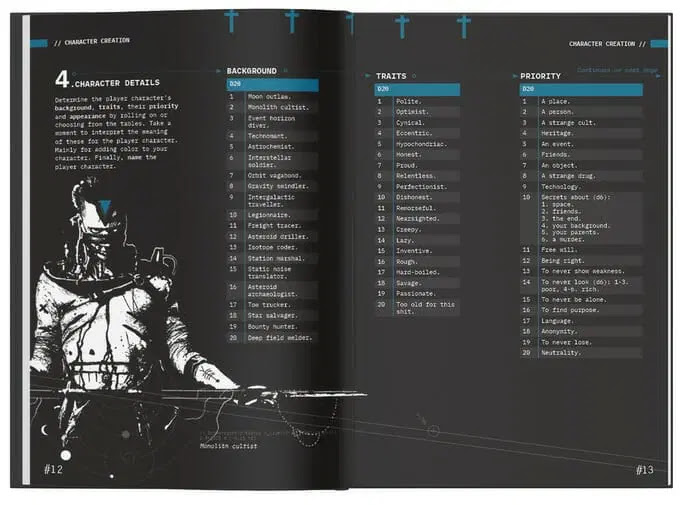
Her background information... and this is where I think the game could have done a little better. You see, your character is 4 stats and 6 background information rolls, only one of which -- "origin" gives you anything resembling special abilities. Everything else is fluff.

The origins are; Carbon, Chrome, Punk, Solpod, Velocity Cursed, and Void.

Her origin is Void (of course I rolled Void!-- see Praise The Fallen.) You can pick one of two abilities: A re-shapeable mask or the ability to make electronics crackle with static -- which is odd considering the game states that a static already permeates all electronics. Perhaps her ability should stop the crackling, allow for a communication bonus...?

  • She was something called a Monolith Cultist -- up to you to determine what that was. No abilities.
  • Her allegiance was to the contract, i.e., the highest bidder during what the game calls, The Gem War. No abilities.
  • She is "Relentless." No abilities.
  • Her Drive is a "strange drug." Again... up to you.
  • And she wears a necklace with odd skulls.
  • Her gear is -- a faulty star compass, lock picks, holographic playing cards, and 4 doses of... something.

There is definitely flavor here, but right off the bat, I'm contemplating creating some minor bonuses for each of these things.

The game also features Void Corruption and Mutations, some are abilities and some are fluff. There are rules for space travel, space combat, and exposure to the vacuum of space itself -- not as lethal as one might think as long as help is nearby. A handful of monsters and threats are also included, most of them should be avoided at all costs in true space-horror fashion. A bestiary of sorts, however, will be hungered for. 

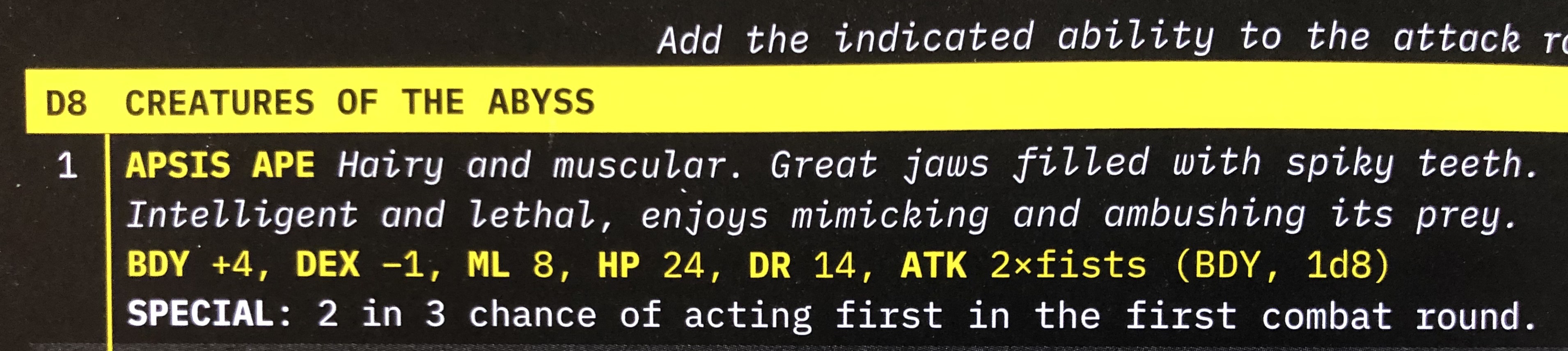
Here's an example of a monster stat-block, the Apsis Ape, which would easily wipe out a party. Clean for the most part, but I think it would be more readable if the values were in white, e.g., DEX in yellow followed by -1 in white. Also, the actual attack roll should've been included where it says (BDY, 1d8) which means: 1d20 + Body vs 12, doing 1d8 damage. In this particular case (BDY, 8+, 1d8) would save the DM from having to do the, albeit brief, calculation.

Classic morale rules are present.

Another huge part of the game is constructing and maintaining your HUB, a ship or a station, in fact, it is really your main motivation. This kind of gives the game a post-apocalyptic survival feel, accept, you are not planet-side, you're in deep space, in a system called Tenebris. Your beginning HUB is bare bones and no advice is given on how to map it out. Fleeting examples seem to prefer something dungeonesque inside the outline of a ship.

If you choose a station as your HUB it will most likely be attached to this massive structure called, the Iron Ring, which circles the moon Inauro like a belt of metal. It's made up of a mixture of derelict ships, stations, huge mining crafts, and all sorts of other junk. Sometimes you walk through it, sometimes you need a shuttle, and sometimes you actually have to jump through space. It's a sort of dungeon in space that includes your home base. An entire campaign can be based here alone with all kinds of hex/dungeon-crawl potential.

Advancement is not as generous as Mörk Borg... which is a good thing, because even as deadly as Mörk Borg is, a few lucky rolls during advancement and your character starts getting pretty tough. In DEATH IN SPACE, you have to spend XP to improve this or that, which will definitely take time, but let's face it, you'll be dead long before then. Also, in a system mostly dependent on 4 main stats, how do explain all of these -2 or -3 Body characters eventually reaching 2, 3 or even higher, going from wimp to strongman? Raising stats needs to be a bit more expensive. This is where improvable (class) abilities would fit nicely, such as weapon specializations, piloting skills, etc., and small bonuses for this or that. 

Where Mörk Borg doesn't take itself too seriously, DEATH IN SPACE certainly does. And I appreciate this. I'm the guy that wants grim/dark to actually be grim/dark!

DEATH IN SPACE is imminently hackable, just like the rest of these, rule-light (OSR???) games and before long, we'll be seeing a shit-ton of hacks. This is actually a perfect stepping stone to a classic Post-Apocalyptic version because of it's scavenger nature. The art is right, the tone is right. Personally, when I look at rules-light games like this, I always want to add to them. I always feel, as cool as they are (and this is a cool fucking game) that they are missing just a little something, a few more options perhaps (especially during character creation.) I never want to look at a game, right away, as a one-shot. And yes, I want it to be dangerous, but I want my character to survive a few hits... but no more! -- just enough to have some fun. Just enough to decide, maybe it's time to fall back. Action heroes are cool, combat is cool!

Like I said, beautiful book, cool game. 

Glad I backed.


Sunday, April 17, 2022

GAMMA WORLD


I owned (own) all the usual TSR stuff, D&D, Marvel Super Heroes, Star Frontiers, Top Secret, I once played Boot Hill and I even played Indiana Jones, but I never owned GAMMA WORLD, nor did any of my friends, nor do I even remember seeing it in any of the stores, because, I would have bought it. The exception to this was in the early 90s when I purchased the 4th edition of the game, this one...


It's strange how this classic game evaded me and mine throughout the 80s. We all knew about it and it would come up in conversations, "Ever play GAMMA WORLD?" By the time I acquired this copy and read through it though, I wasn't all that impressed, as it seemed too D&D-ish to me at a time when I was looking for newer mechanics. I soon entered a non-gaming phase and even when I resumed rolling dice, GAMMA WORLD sat there, in a box, mostly untouched... for 30 years.  And it's current condition -- like brand new.

Of course, in recent years, one way or another, I've been able to scan through the various editions of GAMMA WORLD and it seems that this edition (4th) (not to be confused with the one based on D&D 4E) is regarded by many as the best, or at the very least, one of. 

I've had post-apocalyptic stuff on my brain lately, so I dug this out, scanned through it and rolled up a character or two.

This is the game that Numenera is trying to be.

Esthetics and some other things (this is not a proper review, it's more of a stream of thought.)

I find the cover boring, but a lot of classic GAMMA WORLD cover art is present inside along with cool inked works, many by the great Larry Elmore. The interior layout is black and white laced with green highlights and charts. It's not the most exciting book to flip through, but it works.

After scanning through and rolling up characters, I see so much potential to my modern OSR eyes. It's connection to D&D is not a bad thing at all, in fact there are cool mechanics here that I'm surprised never actually made the jump over to D&D proper.   

The character I rolled up (drawn above)...

Btw, this isn't a bad character sheet, still, I should draft my own.

Characters are made up of Genotypes (race), Class, and Cryptic Alliance (sort of like Planescape's Sects -- how you see the world along with the pros & cons of that. Where-as Planescape's Sects are cool, I don't find the Cryptic Alliances particularly interesting, probably because I don't like my post-apocalypse to be that well organized, but, you never know.) 

Notice the triad, though...

Now if you're familiar with Numenera (a modern game about collecting artifacts from a bygone era) -- your character is an, Adjective Noun who Verbs. Here, you're a Genotype Cryptic Alliance who Classes (e.g., a Pure Strain Human Archivist who Enforces.) It doesn't work, nor is it even stated in that way, but I'm convinced there's a connection.

The Genotypes are: Pure Strain Humans, Altered Humans (mutants), Mutated Animals, and Sentient Plants. I get the impression that many people play/played GAMMA WORLD as goofy/gonzo. I don't like goofy shit. I like dark and serious, and that's how I would run my GAMMA WORLD game -- dark, survival-oriented. It would almost have to be a hex-crawl thing where you're always looking for food & supplies because that's what the post-apocalypse would be (and yes I've heard of Mutant: Year Zero.)

Classes are (with their Numenera counterparts): Enforcer (Glaive), Esper (Nano), Examiner (all of them), and Scout (Jack.) Numenera also has a Mutant class. I like the archetypes in theory, but feel compelled to redesign all of them. The class skills just feel... meh

You have an AC and an MD (mental defense) that are target numbers for foes to hit and you have Health, Use Artifacts, Robot Recognition (this is actually how well robots recognize you as "human" and thus, obey) Stealth, Remain Unseen, and Perception which are all saving-throw or other types of rolls (actually, Perception functions like AC vs. Stealth or Remain Unseen attempts, btw, Stealth and Remain Unseen, is redundant.) These derived stats are pretty cool and are the concepts that I'm surprised D&D never adopted, especially MD.

Hit Points are a number of D6s equal to your Constitution + 1d6 per level up to 10th (BTW, your stats are: Physical Strength, Dexterity, Constitution, Mental Strength, Intelligence, Charisma, and Senses, with the same bonuses as modern versions of D&D and are mostly generated by 4d6 drop the lowest.) It seems like a lot of hit points, but weapons and creatures in this game do a lot of damage and you're only supposed to heal 1 point per day -- that's rough.

Poison and Radiation rules are cool and are basically an Intensity Rank plus a D20 roll vs. your Health score, the higher the roll, the worse the effect. Radiation can also cause mutations.

Lets take a look at the mutations I rolled for this Altered Human, Enforcer (5 physical, 0 mental):

  • Gas Generation: I rolled Poison Gas. You then have to come up with a delivery method on your own, I chose breath, but there should've been a random table to roll on. 
  • Heightened Taste: She can taste a tiny bit of poison or chemical to identify it. Could be useful, but it's minor and might not show up in-game too much. Conveniently, this makes sense considering her Poison Gas Breath. 
  • Tail: I rolled, "New Body Part" then rolled, "Tail" (out of 10 possibilities.) There are NO perks listed, other than to say that the new body part "should be useful." Wow. That is shockingly lame. Her Tail could've been barbed, it could improve dexterity/balance, be prehensile, etc... There should have been extensive benefits to roll for.
  • Infravision: Self explanatory. I used to hate rolling this power in Marvel, but there are ways to make it useful. No mechanical benefits really.
  • Sonar: (Either antennae or ears) She receives info on all objects within 100 meters. This should also have benefits for surprise and initiative and such, but doesn't. 

Not all mutations are beneficial... this is cool.

Artifacts. So many are lame. I don't care to find a toaster or a stapler or a blow dryer. This is where Numenera does it better. There, all Artifacts are useful and the Numenera depletion rules are great -- for any game. I would also skip the Use Artifacts Diagram, it's cool in a way, but tedious (imagine going through all of that rolling just to find out you've found a pencil sharpener!) 

GAMMA WORLD has a monetary unit called the Domar (Numenera has Shins.) I wouldn't have a monetary system at all, it should only be scavenging and barter. So I randomly rolled three artifacts for her to start with and got a Lute, a Shotgun, and a Flash Light. Shotguns do 4d6 damage.

Chain and plate mail and such exist here, but I would portray them differently, Mad Max-ish, not medieval. I would also add some kind of penalty to heavy armors or have them deplete. 

Monsters are basically mutated plants/animals/robots of a 70s/80s imagination. Some are cool, but I would go the Numenera route here, draw something strange -- give it stats! 

It's a shame that Numenera's mechanics are dumb, because... cool ideas. But GAMMA WORLD'S mechanics are mostly not dumb. These GAMMA WORLD rules laced with Numenera's Artifacts and character creation could result in one of the coolest games of all time.

Still, GAMMA WORLD 4th Edition, on it's own and without modification is pretty damn solid.

To those of you who enjoyed this game... I salute you!


Sunday, April 3, 2022

Castles & Crusades Monster Stats, The Riddle That Is...


Castles & Crusades again.

The Troll Lords do a great job of sifting through folklore to find obscure creatures and fairies to spice up your game. Below is the Becolaep. The Becolaep is a medium sized, spectral witch, undead, incorporeal, chaotic-evil, life-draining... thing. Nothing really new here. But...


How about HD: 4d20... 

And 2 claws that do 3d10 damage...!

And a Life-Draining touch that drains 1d20+4 hit points (double on a critical hit) which in turn heals the Becolaep, 1d20+4...??? (5-24... that's quite a range!)

Before I go on, let me talk about the stat blocks in general. First, C&C has the perfect balance of information, somewhere closer to B/X than AD&D. However, I don't like that the listed attacks do not include the attack bonus. I know in C&C the attack bonus is equal to the number of HD, but leaving it out creates a little bit of unnecessary work for the DM (CK) even if it is just a glance.

Saving Throws will either say P, M, or both. This means physical and/or mental. If they have the save it is 12 minus their HD, if not, it's 18 minus their HD. This, also, should've been pre-calculated for the reader. In the case of the Becolaep it should read: P: 8, M: 14. If you want people to play your game, make it easy for people to play your game.

The XP for defeating a Becolaep is 500, (+4 per hit point.) I have no idea how they came up with this number. In the beginning of the book there is an XP chart (like with most other versions of D&D) that helps you calculate a monster's XP. Using said chart, I can not come up with 500, even taking into consideration undead traits, which you must look elsewhere for. Which is fine, such charts are just a rough guideline. A lot of monsters in this book don't seem to match up with it though. Again, it's OK, just an observation. I find a lot of traditional monster XP to be low anyway, as I like to reward for killing and finding treasure. Fighting is fun, always has been, always will be.

About these HD... 

At first I thought a creature's HD might depend on it's type, fey, animal, undead, etc. But...

Below we have a sample page of the rather large section on fairies (this is all taken from the latest printing of Monsters & Treasure, btw) All four are small sized and similar in many ways, including XP, yet one has HD: 1d6, another has HD: 2d4, the others are HD: 1d8, and HD: 2d12. 

There's no logic here. This is not a complaint, btw, I actually like it, as well as the crazy damage, just trying to figure it out...

Now, part of the fun of the OSR, is that you can throw stats around, you can be whimsical, you know like -- how about HD: 3d12 and 8d4+7 bite damage, why? -- because.

Now I like this kind of whimsical design, to a degree, and I hope this is sort of what's going on in Castles & Crusades, because, if you are going to use this ruleset, it opens things up, liberates you to really have fun and get creative with it (not that you can't do that with any other version of our favorite game.) And it definitely makes the game more dangerous. And D&D should be dangerous. 

I like the fact that many monsters in C&C do damage like 2d10 or 3d10, but it's usually the more obscure monsters or occasionally a radically different take on an old one. Traditional monsters seem to have more traditional damage, for example, the Minotaur does damage: by weapon +4 -- that's lame as hell for such a savage beast, and the traditional, supernaturally strong Vampire only has a single 1d6 slam! A Troll's claws only do 1d4 and it's bite is 2d6, or by weapon +3 (another flaw, it lists all three attacks for the Troll but doesn't say 2 claws, 1 bite, "or" 1 weapon, it simply says claws, bite, weapon, or perhaps more logically it should say: 1 bite + ((2 claws or 1 weapon.)) And the Troll Lords really love their Valkyrie: (Valkryja in C&C) 15d8 HD, 25 AC, and this is exactly what it says for damage: Spear (8d10), Axe (12d12), Sword (10d8), Bow (6d8) as opposed to: by weapon +7, in AD&D.

So anyway, why 4d20 HD? (That's 4-80 hit points, btw)  I'll say this, no two Becolaeps will be the same as they'll run the gamut from super-weak to super-strong. And be glad that, all though they may have upwards of 80 hit points and have two claws that do 3d10 damage, their saves are mediocre and they will miss a lot in combat with only a +4 to-hit. 

Check out the Krampus...

It only has 4d6 (12 maybe 16) hit points, an average AC (14) and is only worth 55 XP (with no treasure.) But look at that damage in one round, 1d12, 1d10, and 2d20 (2-40!!!... and notice it only says claw, not claws, so 2d20...  twice???) The Krampus will either die in the first round or kill half the party!

Time to learn a new kind of fear.


Medieval Doors

These are not like modern doors. No knob to turn. No door handle. Often, the outside has a keyhole and nothing else. Maybe an iron loop or r...